OmegaMom has linked to a sample American Citizenship quiz. I got 80%, but considering the fact that I'm Canadian, that's not half bad. Here's a scary proposition. How about taking a Canadian citizenship practice quiz? Here's where you can take one. Set it to 20 questions and have at it... eh.
I got one question wrong (I should've known that Manitoba was considered a "prairie province", to me it was always kinda in-between. )
Thursday, June 29, 2006


A Simple GUI For UFRaw-batch processing
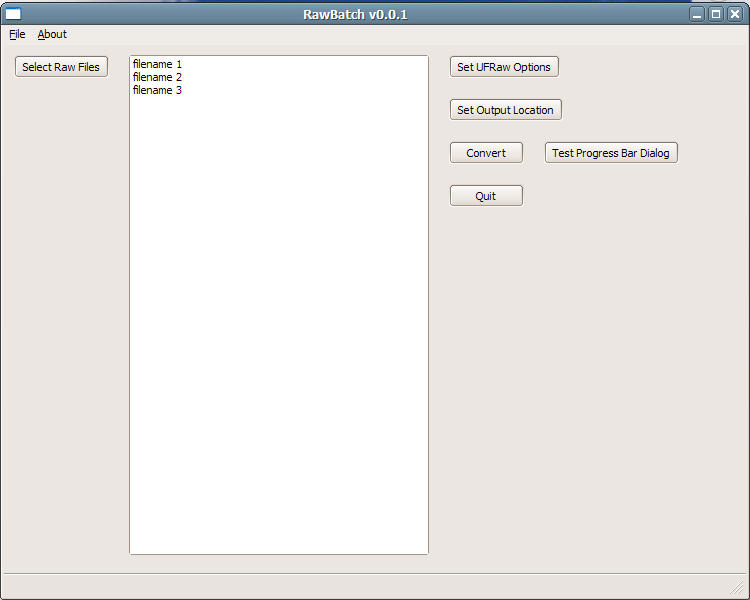
About 3 months ago I started a separate blog called Design-Notes to document some of my programming work. Since that time I've done very little programming (big surprise). Anyway, I've decided to warm up my coding chops (what piddly few I have) by tackling something a little more enjoyable. I'm writing a very simple GUI for the UFRaw-batch command line utility I wrote about a couple of days back. Here's a screenshot (this one from XP although the screenshot on my design-notes blog was from within Linux). If you're interested in python, wxpython or a fellow newbie programmer, you might find it interesting.

Wednesday, June 28, 2006
Linux Reality Podcast
Linux Reality is a podcast for the new linux user. Currently host Chess Griffin is going over Ubuntu Dapper (I found his podcast during a blog search for Ubuntu) but it's not really a linux distro review show. His past shows covered things like the linux file system heirarchy, command line basics and file permissions among other newbie topics. This is just what I've been searching for. If you're new to linux or wanting to try it out, you might enjoy this one. He gets a lot of email and voice mail from more experienced linux users so it's quite possible to benefit from it even if you're past the newbie stage.
Some new ideas for those of Jill's ilk....
Dottie has a few new ideas regarding social activist art projects in her post regarding the Jill Greenspun/Thomas Hawk matter I posted about earlier:
- punch old people - to highlight the helplessness and lonliness of old people in our society
- burn homeless peoples cardboard box shelters - to highlight the division between the rich and the poor
- loot, pillage and rape an entire rural village - to highlight the co-opting of rural communities by commuting urbanites
Sarcasm - now that is a thing of beauty.
- punch old people - to highlight the helplessness and lonliness of old people in our society
- burn homeless peoples cardboard box shelters - to highlight the division between the rich and the poor
- loot, pillage and rape an entire rural village - to highlight the co-opting of rural communities by commuting urbanites
Sarcasm - now that is a thing of beauty.
Let's Diagram a Digital Photography Workflow!
As noted in my previous post "My Latest Endeavour: Developing a Digital Photography Workflow in Linux", I'm trying to nail down a good digital photography workflow. As it happens, I came across a neat web app called Gliffy which lets you do diagramming (like Visio) inside of your browser. And naturally as web apps often do, it has publish and collaborate features.
Now keep in mind I've used the service for all of 10 minutes (literally!) but I've started to create a simple diagram to describe my digital photography workflow. I'll publish it here largely as an experiment to see what it appears like on my blog, but also I am willing to add collaborators for anyone interested in helping to diagram a digital photography workflow. It represents 10 minutes of work so feel free to improve and expand it.
I work in a largely visual medium (a sea of CAD dwgs to be exact) but I'm a complete newbie to this type of diagramming. So if you want to help develop what could be a nice visual description of a good photographic workflow, I think you might need to email me so I can add you to the collaborators list. Although there might be some easier way for me to hook you up to it. If you're interested, let me know via email or in the comments below. Remember, I've used the service for 10 minutes so to call me a Gliffy newbie would be a severe understatement.
Here's what I've got so far:

Update:
My thanks go to Chris Brogan for the shout-out at lifehack.org. Interestingly, he's sent me over 400 visitors to the post over the past 2 days, but not one has sent me an email in order to collaborate on the above diagram. I started it really to get a group of people to work on it and shape it. So if you're interested please send me an email (visit my blog profile at the upper right for my email address) and I'll add you to the group so that you can expand on what I've done. I'm sure people have a lot of great ideas that could improve it iUpdate #2:mmensely.
Update #2:
I've just reset my commenting engine back to Blogger (07-07-06). There were a few comments to this post prior to the switch which are valuable to me and to others. You can still read them here. If you want to leave any other comments, please feel free to do so here on this blog.
Now keep in mind I've used the service for all of 10 minutes (literally!) but I've started to create a simple diagram to describe my digital photography workflow. I'll publish it here largely as an experiment to see what it appears like on my blog, but also I am willing to add collaborators for anyone interested in helping to diagram a digital photography workflow. It represents 10 minutes of work so feel free to improve and expand it.
I work in a largely visual medium (a sea of CAD dwgs to be exact) but I'm a complete newbie to this type of diagramming. So if you want to help develop what could be a nice visual description of a good photographic workflow, I think you might need to email me so I can add you to the collaborators list. Although there might be some easier way for me to hook you up to it. If you're interested, let me know via email or in the comments below. Remember, I've used the service for 10 minutes so to call me a Gliffy newbie would be a severe understatement.
Here's what I've got so far:
Update:
My thanks go to Chris Brogan for the shout-out at lifehack.org. Interestingly, he's sent me over 400 visitors to the post over the past 2 days, but not one has sent me an email in order to collaborate on the above diagram. I started it really to get a group of people to work on it and shape it. So if you're interested please send me an email (visit my blog profile at the upper right for my email address) and I'll add you to the group so that you can expand on what I've done. I'm sure people have a lot of great ideas that could improve it iUpdate #2:mmensely.
Update #2:
I've just reset my commenting engine back to Blogger (07-07-06). There were a few comments to this post prior to the switch which are valuable to me and to others. You can still read them here. If you want to leave any other comments, please feel free to do so here on this blog.
Tuesday, June 27, 2006
Would You Do It?
Although it is not the first time I've seen and read about Jill Greenberg's purported "art" where she induces states of emotional distress upon toddlers and then photographs them, the controversy seems to be growing. Kent Newsome weighs in on Thomas Hawk's current battle with legal threats from the artist due to his original post on the subject.
I've read Thomas's original post and I have to say I agree with his opinion. Perhaps more importantly I agree with his freedom to have that opinion. Is it libel? I'm not sure. But if you read his post he is constantly asserting that this is his opinion. From what I understand of libel and slander, you must make a false statement of fact that damages the person's reputation. It is NOT false that Thomas *thinks* Jill is abusing the children and should be charged. One cannot be making false statements of fact when they're describing their opinion can they?
While I'm not sure about Ms.Greenberg's moral or ethical standards (I don't know her), I can surely say that I don't like what she's doing. It is one thing to capture a moment of pain or anguish (I've done so myself) but entirely another to induce it. Would you do it to your own child? Would you do it to your own child to make money?
I knew a guy back in grade school who supposedly delighted in tormenting various dogs and cats around the neighbourhood. At 12 years old I distinctly remember myself thinking "How can he possibly do that?". I realized back then that some people are just wired differently than others. While taking lollipops away from toddlers to evoke short term stress and anguish may seem so trivial, you have to ask yourself what kind of person would enjoy doing that for money, fame or notoriety.
I'm not going to bash "artists". There are hundreds of examples of art I find distasteful, ugly and pointless (just subscribe to BoingBoing for a week), but the simple act of inducing pain in someone (toddler, adult or animal) for the purposes of fame, money or notoriety just doesn't sit right with my ethics no matter how noble your artistic cause.
And to Ms Greenberg's husband for pointing out in his initial comment to Thomas Hawk:
That doesn't make it right. I will look differently upon those things from this point onward. Thanks (honestly) for exposing this fact too.
I've read Thomas's original post and I have to say I agree with his opinion. Perhaps more importantly I agree with his freedom to have that opinion. Is it libel? I'm not sure. But if you read his post he is constantly asserting that this is his opinion. From what I understand of libel and slander, you must make a false statement of fact that damages the person's reputation. It is NOT false that Thomas *thinks* Jill is abusing the children and should be charged. One cannot be making false statements of fact when they're describing their opinion can they?
While I'm not sure about Ms.Greenberg's moral or ethical standards (I don't know her), I can surely say that I don't like what she's doing. It is one thing to capture a moment of pain or anguish (I've done so myself) but entirely another to induce it. Would you do it to your own child? Would you do it to your own child to make money?
I knew a guy back in grade school who supposedly delighted in tormenting various dogs and cats around the neighbourhood. At 12 years old I distinctly remember myself thinking "How can he possibly do that?". I realized back then that some people are just wired differently than others. While taking lollipops away from toddlers to evoke short term stress and anguish may seem so trivial, you have to ask yourself what kind of person would enjoy doing that for money, fame or notoriety.
I'm not going to bash "artists". There are hundreds of examples of art I find distasteful, ugly and pointless (just subscribe to BoingBoing for a week), but the simple act of inducing pain in someone (toddler, adult or animal) for the purposes of fame, money or notoriety just doesn't sit right with my ethics no matter how noble your artistic cause.
And to Ms Greenberg's husband for pointing out in his initial comment to Thomas Hawk:
this is the EXACT technique used in ads and movies and TV. i'm a producer in two of those mediums and have been through this before, so i know whereof i speak.
That doesn't make it right. I will look differently upon those things from this point onward. Thanks (honestly) for exposing this fact too.
My Latest Endeavour: Developing a Digital Photography Workflow in Linux
I've been working quite happily in Ubuntu Linux lately. Of all the typical tasks I perform on my pc, there have only been two real deal-breakers for me in using Linux on a daily basis at home: Digital Photography and AutoCAD. The latter is something I am willing to forego for the time being - doing CAD work at home is not as high on the list as it used to be ;). Digital photography in Linux is something I'm tackling head-on as of late and I think I'm coming to grips with it piece by piece.
I've found that the barriers to using Linux for my digital photography are being knocked down bit by bit. Such is the relentless progression of the open-source community. If there is an itch, it will eventually be scratched. On the Windows side, I've traditionally used the following tools:
1. Canon's propietary software for downloading the photos onto my pc.
2. Canon's Digital Photo Professional for RAW image tweaking and conversion to jpeg (I shoot RAW most of the time).
3. Adobe Photoshop Elements 4 for image editing and for maintaining a catalog of my images.
4. Flickr for publishing photos for online display (with the side-effect of having a duplicate online backup of at least some of my photos.)
5. Blogger's photo upload for posting specific photos to my blog where I want to have more control than just linking to a Flickr version.
6. Sonic RecordNow for backing up images to DVD for offsite storage.
With Linux I'm finding that I have to really nail down a better-defined workflow but that is not a bad thing. Sometimes being forced to work more thoroughly on a problem can yield new and better results. Here's how things are shaping up at the present time:
1. F-Spot for importing RAW images from the camera to my hard drive.
2. UFRaw (and more importantly its batch mode) for conversion of RAW images to jpeg format.
3. The GIMP for image editing and tweaking.
4. F-Spot for cataloging and tagging of images into a library.
5. Flickr for publishing photos (see #4. for Windows above)
6. Blogger photo upload (see #5. for Windows above)
7. Gnomebaker for backing up images to removeable media.
Loose Ends and Comments:
Conclusions:
I'm quite pleased with using Ubuntu Linux at home with regards to digital image workflow. There are still challenges to overcome. Call me a masochist, but I do enjoy the challenges. As a card-carrying linux newbie, please point out any corrections or helpful information that you might have or know about in a email to me or even better, post it in the comments.
I've found that the barriers to using Linux for my digital photography are being knocked down bit by bit. Such is the relentless progression of the open-source community. If there is an itch, it will eventually be scratched. On the Windows side, I've traditionally used the following tools:
1. Canon's propietary software for downloading the photos onto my pc.
2. Canon's Digital Photo Professional for RAW image tweaking and conversion to jpeg (I shoot RAW most of the time).
3. Adobe Photoshop Elements 4 for image editing and for maintaining a catalog of my images.
4. Flickr for publishing photos for online display (with the side-effect of having a duplicate online backup of at least some of my photos.)
5. Blogger's photo upload for posting specific photos to my blog where I want to have more control than just linking to a Flickr version.
6. Sonic RecordNow for backing up images to DVD for offsite storage.
With Linux I'm finding that I have to really nail down a better-defined workflow but that is not a bad thing. Sometimes being forced to work more thoroughly on a problem can yield new and better results. Here's how things are shaping up at the present time:
1. F-Spot for importing RAW images from the camera to my hard drive.
2. UFRaw (and more importantly its batch mode) for conversion of RAW images to jpeg format.
3. The GIMP for image editing and tweaking.
4. F-Spot for cataloging and tagging of images into a library.
5. Flickr for publishing photos (see #4. for Windows above)
6. Blogger photo upload (see #5. for Windows above)
7. Gnomebaker for backing up images to removeable media.
Loose Ends and Comments:
- I would like to find a better method of importing images from my camera in Linux. I'm sure there is one, but I currently can't find an application that will let me see thumbnails of the RAW files prior to importing the images from the camera. While F-Spot imports my .CR2 files, it doesn't show me thumbnails of these images *prior* to importing them.
- While utilizing UFRaw in batch mode on the command line works flawlessly, it makes converting 15 out of 25 RAW images a bit of a hassle (it's much easier to convert one or convert all of them). A simple GUI with RAW thumbnail selection would be ideal here. Perhaps my interest in Python programming will come in handy here [cue big guffaw].
- Currently UFRaw doesn't carry over the EXIF metafile information when it converts my .CR2 images to jpeg. I have to use a program called ExifTool to do this. I just realized this so the latest photos I've posted to Flickr are missing any EXIF information. (Everyone should realize that not all image editing software will keep all the EXIF info intact when editing an image, so sometimes when you edit a photo before uploading it to Flickr it might be missing some or all of the EXIF info. - something that might piss off Kent Newsome ;) )
- Printing photos in Linux is still a big unknown for me. I'm a bit unsure about colour management and printer control within Linux. Then again, I haven't spent a lot of time on it.
Conclusions:
I'm quite pleased with using Ubuntu Linux at home with regards to digital image workflow. There are still challenges to overcome. Call me a masochist, but I do enjoy the challenges. As a card-carrying linux newbie, please point out any corrections or helpful information that you might have or know about in a email to me or even better, post it in the comments.
Wednesday, June 21, 2006
Did you know about Teleflip?
I didn't realize this service existed. If you want to send an SMS message to someone's cell phone, you can just put the number followed by '@teleflip.com' and send them a short email. In a matter of a couple of minutes they will receive your email as an SMS message on their phone. (eg. say your cell number is (444)555-6809, then you would send an email from your pc to '4445556809@teleflip.com').
You don't have to register anything with the site (you don't even have to visit it). The service is free although your provider may charge you for receiving SMS messages depending on your plan.
Caveats?
It currently only works in North America (Canada, US, Caribbean, Hawaii, Guam).
There is the chance that spammers might use the service. However they have a 'One Strike You're Out' policy whereby if you receive spam that has been forwarded by Teleflip, you can contact them with the details and they will put a stop to the spammer.
Is it useful? Dunno for sure. I could see myself sending a quick email to my own cell for reminders (pick up milk tonight!) or to send a quick note to a friend or someone. I much prefer talking or a proper email, but it does sound kinda nifty.
You don't have to register anything with the site (you don't even have to visit it). The service is free although your provider may charge you for receiving SMS messages depending on your plan.
Caveats?
It currently only works in North America (Canada, US, Caribbean, Hawaii, Guam).
There is the chance that spammers might use the service. However they have a 'One Strike You're Out' policy whereby if you receive spam that has been forwarded by Teleflip, you can contact them with the details and they will put a stop to the spammer.
Is it useful? Dunno for sure. I could see myself sending a quick email to my own cell for reminders (pick up milk tonight!) or to send a quick note to a friend or someone. I much prefer talking or a proper email, but it does sound kinda nifty.
Ta-Da List Hacks Anyone?
I tend to try out a lot of demo applications and freeware. And if I stick with one for more than a week I consider it successful. I've stuck with Ta-Da List (from 37Signals) for several months now, so I guess I'd consider it a wild success. I love the simplicity of it - that's what makes it so appealing and so useful to me - but there are a couple of things I wish it did:
1. I can't import or export a simple text file list from my Ta-Da list. This would be a godsend to me because I want to transfer items (or entire lists) to other formats for printing, formatting or other uses. I can copy and paste single items to a text editor but this is tedious when you're looking at 20 or 30 tasks.
2. There doesn't seem to be a way to move or copy items from one Ta-Da list to another Ta-Da list. Currently I use a master list to manage my ongoing tasks. I would love to be able to grab 5 of those 30 tasks and put them in a separate Ta-Da list just for today. I could prioritize them and focus on completing those tasks without being overwhelmed by the other 25 things I haven't done.
Does anybody have any hacks or tips for accomplishing any of the above things? Or can anyone point me to better places to pose these questions?
1. I can't import or export a simple text file list from my Ta-Da list. This would be a godsend to me because I want to transfer items (or entire lists) to other formats for printing, formatting or other uses. I can copy and paste single items to a text editor but this is tedious when you're looking at 20 or 30 tasks.
2. There doesn't seem to be a way to move or copy items from one Ta-Da list to another Ta-Da list. Currently I use a master list to manage my ongoing tasks. I would love to be able to grab 5 of those 30 tasks and put them in a separate Ta-Da list just for today. I could prioritize them and focus on completing those tasks without being overwhelmed by the other 25 things I haven't done.
Does anybody have any hacks or tips for accomplishing any of the above things? Or can anyone point me to better places to pose these questions?
It only gets better... or is that worse....fear not!
Via Digg.com I found this interesting article about the deepest hole ever drilled. In that article there was a mention of Abe Vigoda (believe it or not) that pointed to an Abe Vigoda status page (currently he's still alive). A quick check on Wikipedia informed me that in fact there was (once) a Firefox extension that would keep an up to date account of Mr. Vigoda's condition. However, pointers to that extension led to this page containing a single strange photo that has seemingly nothing to do with Mr. Vigoda. The weird thing is that I've seen this photo before but I just can't remember where. (Maybe Fark.com?)
Just in case any of you thought the Internet was becoming a useful place to spend your time. Fear not. :)
Just in case any of you thought the Internet was becoming a useful place to spend your time. Fear not. :)
Tuesday, June 20, 2006
Photography Concept 3
This is the third installment of this series on basic photography concepts. We've discussed the concepts of Exposure and Focal Length and Lenses. Today I'm going to cover Depth of Field...
Photography Concept 3: Depth of Field
The concept of Depth of Field (DOF) is one of the key ingredients in cooking up a successful photograph. In simple terms, DOF is the distance in front of, and behind your subject within which objects are within an acceptable level of focus or sharpness. A shallow depth of field means that the sharpness of objects falls off within a short distance in front of or behind your main subject. A deeper, longer or greater depth of field would mean that objects further in front of or behind your main subject are within an acceptable level of sharpness.
There are two major reasons for wanting to control the depth of field when making a photograph:
One of the most prevalent uses of a shallow DOF is when you're taking a shot of a person or animal. You choose a shallow DOF to more effectively isolate that person from the background. This can be quite pleasing, and many times this will distinguish your photograph immediately from the typical snapshot.
Maximum depth of field is many times utilized in landscape photography where you want to capture foreground, middleground and background objects all with an acceptably high degree of sharpness.
Of course shallow and deep DOF is not limited to one genre of photo or another. DOF can be used in many different situations for many different purposes. This is what makes photography such a creative endeavour!
So how do you control depth of field? The amount of DOF achieved is dependent on the aperture, distance to your subject and focal length of the lens. There are many online DOF calculators you can use to calculate the DOF (one of which is here), but for the purposes of this series of posts I think it's more important to give some rough guidelines just to illustrate the concept. You can invest more time in it depending on how important an accurate DOF is to you and your photography.
If you want to isolate a person or object by blurring out the background (and foreground) there are a few things you should do:
If you want to capture a greater depth of field - for instance when you want to include both your friends and the amazing backdrop in the photo and get them both sharp - then there are a couple of things to remember:
Keep in mind the lessons learned in part one of this series. If you're going to keep your overall exposure correct, then you must balance a smaller aperture with a slower shutter speed (and vice versa for a larger aperture). So many times you will find that if you want to maximize the DOF (say using an aperture of f/22) you might end up with a shutter speed that is relatively slow. This might give you a blurry shot if you don't use a tripod to keep the camera rock-steady during the time the shutter is open.
Some other points:
Many DSLR's come with a DOF preview button. Normally when you're looking out the viewfinder of your camera, you're always looking through the lens at it's widest aperture (so the viewfinder image is bright). When you press the DOF preview button, the viewfinder image will darken but you will get a truer sense of what the captured DOF will be. This is indispensible if getting the right DOF is critical to you.
Don't always go for the absolute shallowest possible DOF for those portrait shots of your kids (I'm guilty of this on many of my shots). While it does isolate the subject, you also want to make sure that important areas are not blurred. It is quite possible to find that the eyes of your subject might be sharp while the nose ears are slightly soft and slightly out of focus.
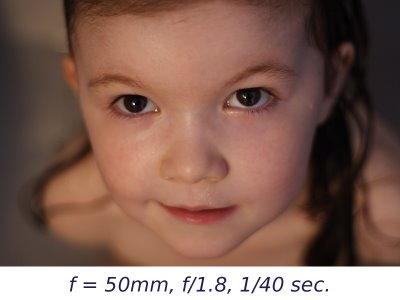
Here's a shot with a shallow DOF. In this case I used a wide aperture (f/1.8) and as you can see, only her face is in focus. Her shoulders and hair are blurry. In this case I liked the very shallow DOF (even her chin is not entirely in focus) and felt it added to the image.
 [click on the image to see a larger version]
If you're going for a very large DOF and finding that you're without a tripod or you need to maintain some minimum shutter speed, don't forget that you can boost your shutter speed by changing to a higher ISO setting. This is something you couldn't really do very quickly on a film camera. And with the increasing quality of digital sensors these days, you can get by with an ISO of 400 or 800 with a still-acceptable level of image noise. This can sometimes mean a critical boost in shutter speed which might let you get a sharp shot when you're without a tripod or other stabilizing device.
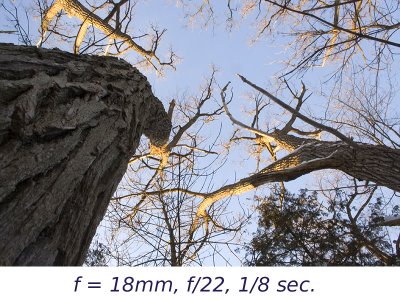
Here's a shot looking up a tree. I wanted to capture the texture of the bark immediately close to the lens and maintain focus up to the top branches. In this case I went with a small DOF (f/22). You'll notice that the shutter speed is relatively slow, so I ended up bracing my camera against the tree to keep it still while the shutter was open.
 [click on the image to see a larger version]
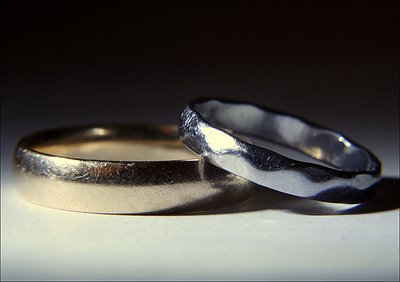
If you're into macro photography you will find yourself trying to maximize the DOF. As you move closer to your subject the DOF becomes very very short. In many cases you want the blurred background but at the same time you might have trouble keeping the entire object in focus.
Here is a shot of my rings with what ended up being insufficient DOF. Notice that the back area of the rings is out of focus.
[click on the image to see a larger version]
This is really the super-basic layman's version of DOF. It's a tool that you will find yourself considering more and more each time you take a photograph. As usual I've only covered the basics, but it's enough to allow you to experiment and get your own feeling for it. And as with so many types of learning, reading about it is never worth the value of actually doing it, so get out and experiment!
[update: I see that Kent Newsome has illustrated the concept of shallow DOF in his recent post Handstands. Notice the focus increase and then drop off as you pass the middle couple of Polly Pockets. Nicely done.]
Additional Interesting Link: Here's a decent online SLR simulator which lets you play around with the aperture and shutter speed settings to give you a feel for exposure and depth of field. [Link]
Photography Concept 3: Depth of Field
The concept of Depth of Field (DOF) is one of the key ingredients in cooking up a successful photograph. In simple terms, DOF is the distance in front of, and behind your subject within which objects are within an acceptable level of focus or sharpness. A shallow depth of field means that the sharpness of objects falls off within a short distance in front of or behind your main subject. A deeper, longer or greater depth of field would mean that objects further in front of or behind your main subject are within an acceptable level of sharpness.
There are two major reasons for wanting to control the depth of field when making a photograph:
- To isolate a subject from its background (using a shallow DOF)
- To better capture objects in the foreground or background of a photograph (using a greater DOF)
One of the most prevalent uses of a shallow DOF is when you're taking a shot of a person or animal. You choose a shallow DOF to more effectively isolate that person from the background. This can be quite pleasing, and many times this will distinguish your photograph immediately from the typical snapshot.
Maximum depth of field is many times utilized in landscape photography where you want to capture foreground, middleground and background objects all with an acceptably high degree of sharpness.
Of course shallow and deep DOF is not limited to one genre of photo or another. DOF can be used in many different situations for many different purposes. This is what makes photography such a creative endeavour!
So how do you control depth of field? The amount of DOF achieved is dependent on the aperture, distance to your subject and focal length of the lens. There are many online DOF calculators you can use to calculate the DOF (one of which is here), but for the purposes of this series of posts I think it's more important to give some rough guidelines just to illustrate the concept. You can invest more time in it depending on how important an accurate DOF is to you and your photography.
If you want to isolate a person or object by blurring out the background (and foreground) there are a few things you should do:
- Use a wide aperture (small f-stop number) - this will depend on the maximum aperture of the specific lens you are using
- Use a longer focal length - although the focal length you choose will likely be governed more by the composition of your photograph than the DOF you're trying to achieve
- Maximize the separation of your subject and the background - put the background further outside of your DOF
If you want to capture a greater depth of field - for instance when you want to include both your friends and the amazing backdrop in the photo and get them both sharp - then there are a couple of things to remember:
- Use a smaller aperture (large f-stop number)
- Use a shorter focal length
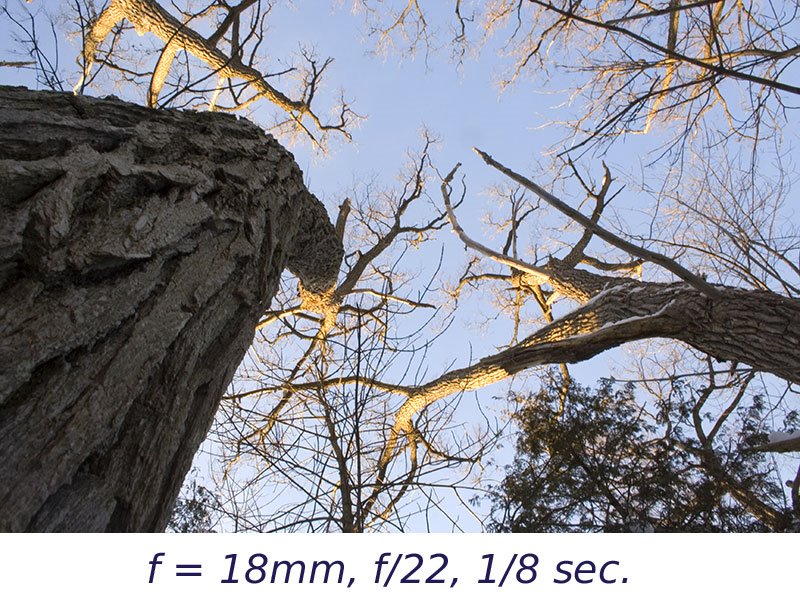
Keep in mind the lessons learned in part one of this series. If you're going to keep your overall exposure correct, then you must balance a smaller aperture with a slower shutter speed (and vice versa for a larger aperture). So many times you will find that if you want to maximize the DOF (say using an aperture of f/22) you might end up with a shutter speed that is relatively slow. This might give you a blurry shot if you don't use a tripod to keep the camera rock-steady during the time the shutter is open.
Some other points:
Many DSLR's come with a DOF preview button. Normally when you're looking out the viewfinder of your camera, you're always looking through the lens at it's widest aperture (so the viewfinder image is bright). When you press the DOF preview button, the viewfinder image will darken but you will get a truer sense of what the captured DOF will be. This is indispensible if getting the right DOF is critical to you.
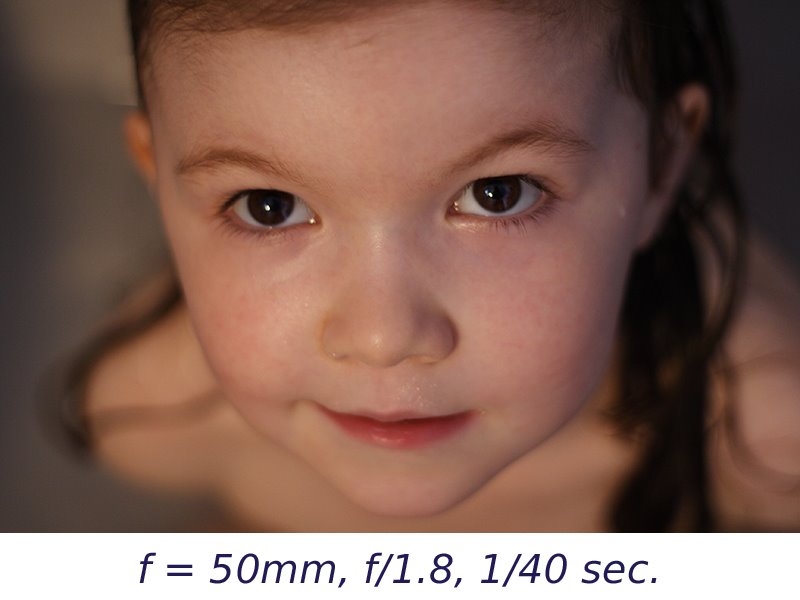
Don't always go for the absolute shallowest possible DOF for those portrait shots of your kids (I'm guilty of this on many of my shots). While it does isolate the subject, you also want to make sure that important areas are not blurred. It is quite possible to find that the eyes of your subject might be sharp while the nose ears are slightly soft and slightly out of focus.
Here's a shot with a shallow DOF. In this case I used a wide aperture (f/1.8) and as you can see, only her face is in focus. Her shoulders and hair are blurry. In this case I liked the very shallow DOF (even her chin is not entirely in focus) and felt it added to the image.
 [click on the image to see a larger version]
If you're going for a very large DOF and finding that you're without a tripod or you need to maintain some minimum shutter speed, don't forget that you can boost your shutter speed by changing to a higher ISO setting. This is something you couldn't really do very quickly on a film camera. And with the increasing quality of digital sensors these days, you can get by with an ISO of 400 or 800 with a still-acceptable level of image noise. This can sometimes mean a critical boost in shutter speed which might let you get a sharp shot when you're without a tripod or other stabilizing device.
Here's a shot looking up a tree. I wanted to capture the texture of the bark immediately close to the lens and maintain focus up to the top branches. In this case I went with a small DOF (f/22). You'll notice that the shutter speed is relatively slow, so I ended up bracing my camera against the tree to keep it still while the shutter was open.
 [click on the image to see a larger version]
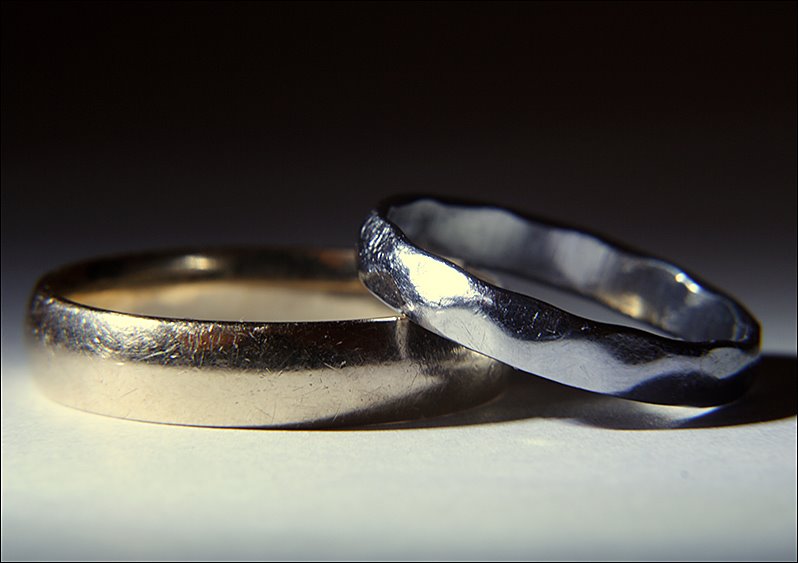
If you're into macro photography you will find yourself trying to maximize the DOF. As you move closer to your subject the DOF becomes very very short. In many cases you want the blurred background but at the same time you might have trouble keeping the entire object in focus.
Here is a shot of my rings with what ended up being insufficient DOF. Notice that the back area of the rings is out of focus.
[click on the image to see a larger version]
This is really the super-basic layman's version of DOF. It's a tool that you will find yourself considering more and more each time you take a photograph. As usual I've only covered the basics, but it's enough to allow you to experiment and get your own feeling for it. And as with so many types of learning, reading about it is never worth the value of actually doing it, so get out and experiment!
[update: I see that Kent Newsome has illustrated the concept of shallow DOF in his recent post Handstands. Notice the focus increase and then drop off as you pass the middle couple of Polly Pockets. Nicely done.]
Additional Interesting Link: Here's a decent online SLR simulator which lets you play around with the aperture and shutter speed settings to give you a feel for exposure and depth of field. [Link]
Saturday, June 17, 2006
Shared Annoyance
The Earthlink nausea is obviously contagious. Dave Winer writes today:
But of course I could be wrong. In fact I must be. I forgot that Steve Gillmor is always right and everyone else (especially Mike Arrington) is almost always wrong. At least that's what Steve thinks.
Update: I should clarify that the 6 minutes I cited above is not all Earthlink related. There is a good chunk of it pre-recorded and placed there for GoDaddy.com. It's something I skip as well. However, I've been listening to Todd Cochrane do his GoDaddy ads on his Geek News Central Podcast for a long time now and I usually don't skip them. Why? Well his are short (relative to Gillmor) and his are recorded live in-line with his podcast, not pre-recorded. For some reason that makes a difference to me.
So let's tell them what we think. Earthlink sucks, and we don't appreciate you wasting our time before we get to listen to the Gillmor Gang.While Steve Gillmor throws bait at Dave Slusher during his latest Daily Gillmor (with Adam Curry) begging for Dave to show how an Earthlink ad should really be done, he's missing the simple fact that having the 6 minute ads is a waste of his listeners time - and consequently a waste of Earthlink's time, at least on this podcast.
But of course I could be wrong. In fact I must be. I forgot that Steve Gillmor is always right and everyone else (especially Mike Arrington) is almost always wrong. At least that's what Steve thinks.
Update: I should clarify that the 6 minutes I cited above is not all Earthlink related. There is a good chunk of it pre-recorded and placed there for GoDaddy.com. It's something I skip as well. However, I've been listening to Todd Cochrane do his GoDaddy ads on his Geek News Central Podcast for a long time now and I usually don't skip them. Why? Well his are short (relative to Gillmor) and his are recorded live in-line with his podcast, not pre-recorded. For some reason that makes a difference to me.
Friday, June 16, 2006
Flash, Design and Some Useful Software
One of the myriad of things that holds my interest from time to time is web design and design in general. I dove into learning HTML and a bit of CSS to create a home page prior to starting this blog. It was by no means a masterwork, but I was pleased with it as a first effort (check it out here if you'd like). I was pleased with it primarily because it was simple, hand-coded and relatively standards compliant. I was never a huge fan of sites that were heavy on Flash (photographer's sites are notorious for this) since I'm usually scrambling for a 'skip this intro' button.
However, Flash seems to have been maturing all the while and there are now some really useful things being done with it. I have just come across what I think is an effective (finally!) and attractive use of flash technology. It's a site showcasing a graphic design contest. It's simple, useful and could be applied to more general purpose projects as well. Check it out. The show is powered by something called Autoviewer which is developed by Airtight Interactive. They also have what looks like a nice (and free) photo gallery flash engine called SimpleViewer that you can use on your own site.
However, Flash seems to have been maturing all the while and there are now some really useful things being done with it. I have just come across what I think is an effective (finally!) and attractive use of flash technology. It's a site showcasing a graphic design contest. It's simple, useful and could be applied to more general purpose projects as well. Check it out. The show is powered by something called Autoviewer which is developed by Airtight Interactive. They also have what looks like a nice (and free) photo gallery flash engine called SimpleViewer that you can use on your own site.
Camera Erotica
You just know you're an engineering-type (who's into photography) when you think this is just plain sexy:

Thursday, June 15, 2006
The Wonder Computer of the 1980's
For someone like me who dove headlong into computing back in the early 80's with a Commodore VIC-20, it don't get any better than this. Take it away Bill...
Wednesday, June 14, 2006
Ice Cream Adventure and Great Writing
Take a bike ride to the ice cream shop with Tony Woodlief and family. It goes from this:
After reading it, I suddenly remember why I'm subscribed to him. Wonderful posts and wonderful writing. Something to aspire to. Check it out.
...only they don't account for that part of me that has absolutely no problem killing someone, and I choreograph in my head exactly how the fight would go and always the bad people end up a bloody broken mess and exceedingly dead.to this:
Now it is all out in the open, the fact that I am a big fat stupid loser. I knew they would find out eventually, but you're never prepared when the dread moment arrives.
After reading it, I suddenly remember why I'm subscribed to him. Wonderful posts and wonderful writing. Something to aspire to. Check it out.
Tuesday, June 13, 2006
The Twit Stars Align - kind of...
Dave Slusher has read my mind with his post regarding the latest Twit episode and Dvorak. I'm getting tired of listening to his schtick as well. Interestingly, in a 'stars are aligning' moment, two things happened:
- Leo Laporte (who I do respect) has posted separate mp3 tracks of the most recent twit episode and put up the challenge for others to mix it together. I would definitely leave the Dvorak.mp3 file out of the mix completely... and...
- Dave Winer posts about being disgusted with Dvorak regarding his sleazy tactics to generate page views. It's about time Dave posted about this. Ever since he took the video I was beginning to wonder if he missed the fact that it was a sleazy thing to do. He also lets us know it was Scoble who was laughing during that video. But then again Scoble has that goofy laugh on just about every recording he's done. It's his trademark and I like it :)
No Hot Sauce - thank you
I think Steve Gillmor missed much of the point when he quoted my previous post. He confirms this misinterpretation in his next post in which he states:
Now I know it is not de rigeur in the blogosphere to take the higher road (and I'm no saint - that's for sure) but I feel it needs a small correction. That little quip in the middle of my previous post was meant to compare the positive drive and energy of Robert Scoble with the generally negative/grouchy/boorish/impatient attitude of one Mr. Gillmor during his Gillmor Gang podcasts. If you've heard any of his recent podcasts you'll know exactly what I mean - take a listen to just about any exchange he has with Mike Arrington on the show and you'll hear it in spades. I'm not sure if it's all for real, but he's made me a bigger fan of Mike - and his phone- as a result.
However I think it's a rather glaring misinterpretation to say I think Steve is a 'complete asshole'. I reserve that term for a select few people I encounter in life - and sorry to disappoint you Steve, but you ain't it. Maybe some people in the blogosphere would appreciate a little hot sauce being added to their blog posts but I'll take mine plain - thank you.
What Steve does get right is his appreciation for the fact that we are listening. Now if he can somehow get us to stop skipping through the first 5 minutes of advertisements maybe he wouldn't be so grumpy ;)
"I appreciate these complaints as much as the praise, not because I enjoy being called clueless, or as Richard in my previous post does, a complete asshole, because these folks are listening."
Now I know it is not de rigeur in the blogosphere to take the higher road (and I'm no saint - that's for sure) but I feel it needs a small correction. That little quip in the middle of my previous post was meant to compare the positive drive and energy of Robert Scoble with the generally negative/grouchy/boorish/impatient attitude of one Mr. Gillmor during his Gillmor Gang podcasts. If you've heard any of his recent podcasts you'll know exactly what I mean - take a listen to just about any exchange he has with Mike Arrington on the show and you'll hear it in spades. I'm not sure if it's all for real, but he's made me a bigger fan of Mike - and his phone- as a result.
However I think it's a rather glaring misinterpretation to say I think Steve is a 'complete asshole'. I reserve that term for a select few people I encounter in life - and sorry to disappoint you Steve, but you ain't it. Maybe some people in the blogosphere would appreciate a little hot sauce being added to their blog posts but I'll take mine plain - thank you.
What Steve does get right is his appreciation for the fact that we are listening. Now if he can somehow get us to stop skipping through the first 5 minutes of advertisements maybe he wouldn't be so grumpy ;)
Sunday, June 11, 2006
Scoble - Setting The Record Straight
So Robert Scoble is leaving Microsoft. He's been able to de-mystify Microsoft without being dishonest and without behaving like a shill. I think he'll do well wherever he goes - he just seems to have that kind of positive drive and energy (Have you ever noticed that he is the complete antithesis of Steve Gillmor? ). It pisses me off however to read this post which apparently broke the story. The author takes pains to sound so authoritative on the situation. Go read Robert's own blog post which sets the record straight. It's nice to see that good guys do not always finish last.
Addendum - see also this follow-on post .
Addendum - see also this follow-on post .
Saturday, June 10, 2006
XGL and Bare Feet
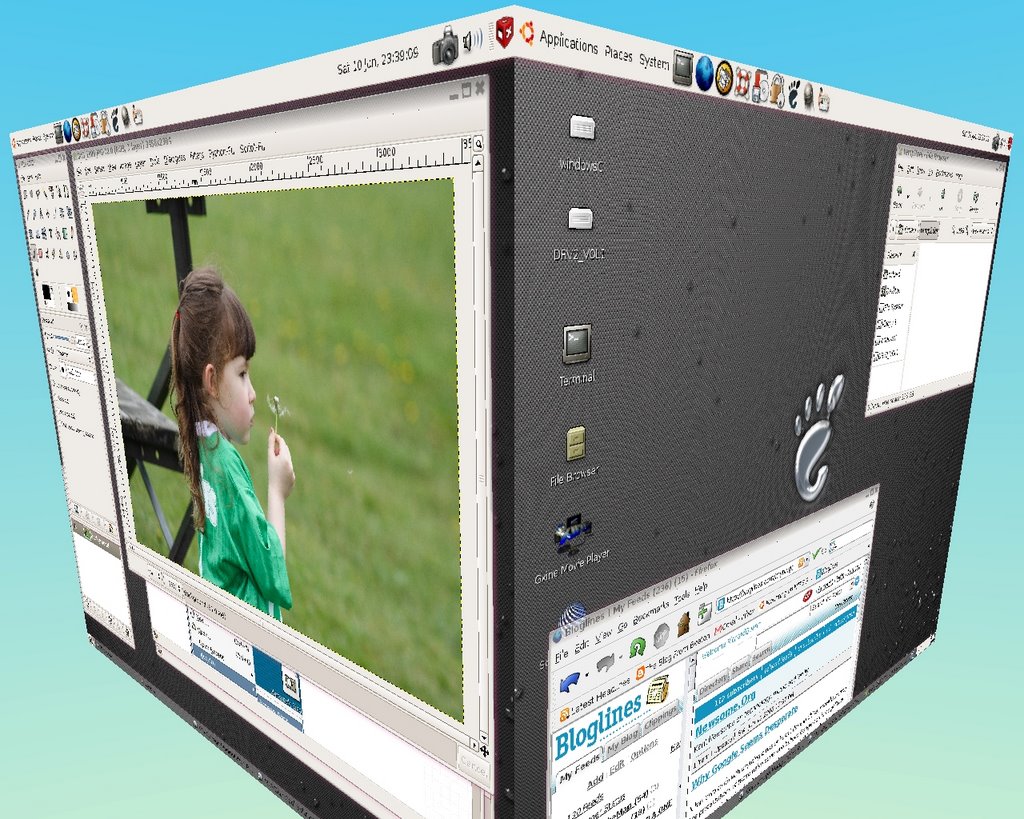
As you may or may not be aware, I've been running a dual boot WinXP / Linux machine here at home for quite some time. I like both operating systems, each has it's strengths and weaknesses. I was bitten by the Unix bug back around '92 when I used a Unix based Sparc system with OpenWindows to do my masters thesis.
Well I've recently upgraded to Ubuntu 6.06 (DapperDrake) on the Linux side of my box and I'm quite pleased with it. I've always had a bit of a penchant for eye-candy and I got the new XGL-Compiz graphics system working in short order. This system shifts the bulk of the window managment to the graphics processor which allows you to do some pretty neat things like having windows that wobble around when you drag and resize them and it has a nice representation of multiple desktops in the rotating 3D cube. So you can run apps on any or all of the 4 desktops and then switch between them. The benefit being that you can better illustrate the multi-desktop concept to new users with this graphical representation (rather than statically switching from one to the next). The XGL implementation allows things like full motion video to keep playing on the cube - and around the corners of the cube while you're rotating it. Quite neat. And keep in mind that I've got a system that is about 2.5 years old with a simple Intel on-board graphics chip - no graphical speed demon in any sense, but it still runs rather smoothly with all this additional eye-candy. Check out this video to see what it can do.
Now is this a threat to the ever-delayed Vista? Probably not. I like how it works and I like the fact that it's open-source developed. But it still takes some extra commitment to getting it up and running and fixing odds and ends. Like many things in Linux, they sometimes take a little more effort to get running smoothly but usually you are rewarded with something quite nice. But that extra effort is something that 95% of the mainstream PC user population wouldn't be interested in spending. If they can get Dell - or someone else - to start putting Ubuntu as the default OS on a series of PC's you might have something. I do believe that at one time you could order Linux based PC's online from Wal-mart, not sure if that's still true.
No matter. I have a great, stable, open-source OS with very nice eye-candy now and I've also got XP for those few things that Linux doesn't handle yet to my tastes.
Last night, my four year old daughter came and stared at my computer desktop as I was working and after I dragged a window across the desktop she said, "Make that window jiggle again Daddy.." and then seeing the dektop wallpaper she said, "Move that window away... show the bare foot again, that's neat.". Maybe the Gnome/Linux/Ubuntu camp has a future user already. :)
Note To Self...
I've always thought John Dvorak was an attention hungry loudmouth - short on personal ethics and long on dubious scruples. I was right.
Photography Concept 2
In the first post of this series I covered Exposure. Now we'll go into the basics of focal length and how it relates to camera lenses and your photos.
Photography Concept 2: Focal Length And Lenses
The 'focal length' of a lens is the distance from the optical centre of the lens to the film or sensor plane, measured in mm. The "f" in "f-stop" is the focal length. Typical 35mm SLR lens focal lengths range from fisheye lenses which have approximately 10mm focal lengths up to super-telephoto lenses with 1200mm focal lengths - that's almost 4 feet(!) to you imperial system holdouts.
Now before we wade any deeper into the lens pool, I think we better clear things up straight away when it comes to DSLR (Digital Single Lens Reflex camera) vs 35mm film lenses. Unless you buy a 'full frame' DSLR, the sensor in your camera is somewhat smaller than that of a traditional 35mm film frame - which incidentally is 36mm x 24mm. I believe Canon (and possibly Kodak) are the only manufacturers who offer full-frame DSLRs - in fact I'm not sure if Kodak sells these full frame DSLRs anymore. Anyways, what this means is that if you're a peasant like me, you're dealing with a "crop factor". On my Canon Rebel XT this crop factor is 1.6, but it can vary between camera models. Simply put, a lens that has a focal length of 200mm on a 35mm film camera (or full-frame DSLR) will behave as if it has a focal length of 200mm x 1.6 = 320mm on my DSLR camera. A 50mm lens on my old film camera will behave like a 50 x 1.6 = 80mm lens on my DSLR.
I'm not going to delve into the dirty details of why this happens but do remember that the actual focal length of the lens is unaltered. What is actually happening is that the sensor is taking only a 'cropped' portion of what a full frame sensor would capture - hence the term 'crop factor'. It behaves like a longer lens in some respects but not in others - more on this in a few moments.
The important thing to remember for the remainder of my discussion here (and any time I state the focal length of a lens) is that I'm describing the 35mm focal length of the lens - not the length modified by the cropping factor.
Also note that there are fixed lenses and zoom lenses. Zoom lenses allow for a range of focal lengths while fixed lenses are, well... fixed.
Enough with the fiddly bits. Here are the primary reasons why you care about the focal length of the lens: Image Composition and Perspective Characteristics.
Image Composition: The length of the lens will determine your angle of view. A relatively short lens will give you a wide angle of view and a longer lens will give you a narrower angle of view. The length of the lens will also determine the size of your subject in relation to the entire frame of the picture. So with a longer focal length a subject will take up more of the available frame than with a shorter focal length lens - assuming the distance between you and that subject remains constant. If your subject is far away, or if you want your subject to fill the frame, that crop factor we talked about actually helps (remember, that 200mm lens is behaving like a 320mm lens). Of course on the other end of things, that 28mm lens is behaving like a 45mm lens, so you're losing out on the wide angle end of things. I tend to shoot with longer focal lengths more often, so I happen to like the crop factor. If you tend toward wide angle shots, you'll have to pony up for wider lenses or a full-frame DSLR to get your fix.
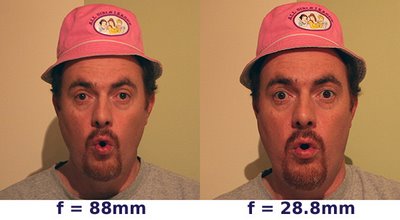
Perspective Characteristics: The focal length of the lens also affects how perspective is represented in a photograph. Shorter focal lengths will tend to accentuate depth while longer focal lengths will tend to flatten things out. There will be times when you want to accentuate depth (to enhance close-up action shots or emphasize shape or size). And of course there will be times when you need to flatten things out - like when you're taking a portrait shot of your Aunt Bessy, the one with the huge nose. In fact you will find that a focal length of 80mm - 120mm will yield much more flattering portraits of people's faces than if you shoot with focal lengths in the 28-50mm range - and that goes for people with normal sized noses as well. Refer to the comparison photo below to see the kind of difference perspective can make in a portrait. Note however that the crop factor on an DSLR camera DOES NOT change the perspective characteristics of the lens. So the way my 50mm lens represented perspective on my film SLR is unchanged on my DSLR. The magnification of the subject is greater, but the perspective characteristics are no different.
Now you might think that someone writing a post about understanding photography might want to showcase his best work. Here's where I surpise you. Instead of hitting you with a quality photograph, I'll hit you with self-deprecation. Take a look at the comparison shot below. After you're all done saying 'Man that guy's sure got some stones to post that!' you will undoubtedly notice that while both portraits are undeniably horrifying, the one taken at a focal length of 88mm is significantly more appealing in terms of proportion and perspective... relatively speaking of course. Have I illustrated the point? I hope so. And for the record, it was 11:30pm after a long day at work. And if you tell my daughter I was wearing her hat, I'll hunt you down.
 My intent with this series of posts is to illustrate the most basic and most important concepts regarding photography. I didn't necessarily want to get diverted into providing a series of quick tips for people - because sometimes giving people shortcuts to an answer prevents them from learning the basis for the solution which is much more valuable in my opinion.
However I am nothing if not easily dissuaded. There are a few basic tips that can make a huge difference in your photography. First, before pressing the shutter button, look around to all the corners and edges of the viewfinder (or LCD screen) and all the places that are not your subject. It is absolutely amazing how easy it is to miss that telephone pole extending out of Uncle Leo's head, or those 16 empty beer cases propped up in the background of the group portrait at your family barbecue. Second, zoom in (with your lens or your feet) to get you subject large enough in the frame. Once you feel your close enough, move in some more. Don't be afraid to really fill the frame with your subject, you'll be surprised at the difference. And finally (for now anyway) remember that people portraits will usually look more attractive at focal lengths of around 80 to 120mm - or even longer. So even with a point and shoot (non-SLR) camera, it is sometimes wise to step back a bit and zoom your lens to a longer focal length before shooting. You might be pleased with the results - but not at 11:30pm on a weeknight ;)
As you might be able to tell, this post was not about describing all the different types and relative merits of different lenses (wide-angle vs telephoto, zoom vs fixed, etc.). There are a huge number of online sources for good information on those subjects - much more detailed than would be appropriate for this series of posts. Along the way I will try to point you to good sources for information that extends past the scope of what I'm writing. Good additional information on lenses can be found here and here. Additional articles on crop factor and focal length can be here and here respectively.
As always, post your comments or email me if you've got an suggestions or complaints.
Photography Concept 2: Focal Length And Lenses
The 'focal length' of a lens is the distance from the optical centre of the lens to the film or sensor plane, measured in mm. The "f" in "f-stop" is the focal length. Typical 35mm SLR lens focal lengths range from fisheye lenses which have approximately 10mm focal lengths up to super-telephoto lenses with 1200mm focal lengths - that's almost 4 feet(!) to you imperial system holdouts.
Now before we wade any deeper into the lens pool, I think we better clear things up straight away when it comes to DSLR (Digital Single Lens Reflex camera) vs 35mm film lenses. Unless you buy a 'full frame' DSLR, the sensor in your camera is somewhat smaller than that of a traditional 35mm film frame - which incidentally is 36mm x 24mm. I believe Canon (and possibly Kodak) are the only manufacturers who offer full-frame DSLRs - in fact I'm not sure if Kodak sells these full frame DSLRs anymore. Anyways, what this means is that if you're a peasant like me, you're dealing with a "crop factor". On my Canon Rebel XT this crop factor is 1.6, but it can vary between camera models. Simply put, a lens that has a focal length of 200mm on a 35mm film camera (or full-frame DSLR) will behave as if it has a focal length of 200mm x 1.6 = 320mm on my DSLR camera. A 50mm lens on my old film camera will behave like a 50 x 1.6 = 80mm lens on my DSLR.
I'm not going to delve into the dirty details of why this happens but do remember that the actual focal length of the lens is unaltered. What is actually happening is that the sensor is taking only a 'cropped' portion of what a full frame sensor would capture - hence the term 'crop factor'. It behaves like a longer lens in some respects but not in others - more on this in a few moments.
The important thing to remember for the remainder of my discussion here (and any time I state the focal length of a lens) is that I'm describing the 35mm focal length of the lens - not the length modified by the cropping factor.
Also note that there are fixed lenses and zoom lenses. Zoom lenses allow for a range of focal lengths while fixed lenses are, well... fixed.
Enough with the fiddly bits. Here are the primary reasons why you care about the focal length of the lens: Image Composition and Perspective Characteristics.
Image Composition: The length of the lens will determine your angle of view. A relatively short lens will give you a wide angle of view and a longer lens will give you a narrower angle of view. The length of the lens will also determine the size of your subject in relation to the entire frame of the picture. So with a longer focal length a subject will take up more of the available frame than with a shorter focal length lens - assuming the distance between you and that subject remains constant. If your subject is far away, or if you want your subject to fill the frame, that crop factor we talked about actually helps (remember, that 200mm lens is behaving like a 320mm lens). Of course on the other end of things, that 28mm lens is behaving like a 45mm lens, so you're losing out on the wide angle end of things. I tend to shoot with longer focal lengths more often, so I happen to like the crop factor. If you tend toward wide angle shots, you'll have to pony up for wider lenses or a full-frame DSLR to get your fix.
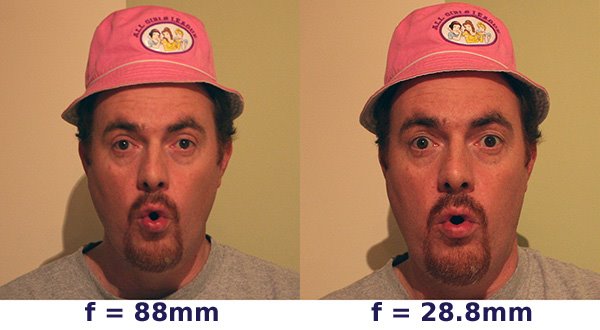
Perspective Characteristics: The focal length of the lens also affects how perspective is represented in a photograph. Shorter focal lengths will tend to accentuate depth while longer focal lengths will tend to flatten things out. There will be times when you want to accentuate depth (to enhance close-up action shots or emphasize shape or size). And of course there will be times when you need to flatten things out - like when you're taking a portrait shot of your Aunt Bessy, the one with the huge nose. In fact you will find that a focal length of 80mm - 120mm will yield much more flattering portraits of people's faces than if you shoot with focal lengths in the 28-50mm range - and that goes for people with normal sized noses as well. Refer to the comparison photo below to see the kind of difference perspective can make in a portrait. Note however that the crop factor on an DSLR camera DOES NOT change the perspective characteristics of the lens. So the way my 50mm lens represented perspective on my film SLR is unchanged on my DSLR. The magnification of the subject is greater, but the perspective characteristics are no different.
Now you might think that someone writing a post about understanding photography might want to showcase his best work. Here's where I surpise you. Instead of hitting you with a quality photograph, I'll hit you with self-deprecation. Take a look at the comparison shot below. After you're all done saying 'Man that guy's sure got some stones to post that!' you will undoubtedly notice that while both portraits are undeniably horrifying, the one taken at a focal length of 88mm is significantly more appealing in terms of proportion and perspective... relatively speaking of course. Have I illustrated the point? I hope so. And for the record, it was 11:30pm after a long day at work. And if you tell my daughter I was wearing her hat, I'll hunt you down.
 My intent with this series of posts is to illustrate the most basic and most important concepts regarding photography. I didn't necessarily want to get diverted into providing a series of quick tips for people - because sometimes giving people shortcuts to an answer prevents them from learning the basis for the solution which is much more valuable in my opinion.
However I am nothing if not easily dissuaded. There are a few basic tips that can make a huge difference in your photography. First, before pressing the shutter button, look around to all the corners and edges of the viewfinder (or LCD screen) and all the places that are not your subject. It is absolutely amazing how easy it is to miss that telephone pole extending out of Uncle Leo's head, or those 16 empty beer cases propped up in the background of the group portrait at your family barbecue. Second, zoom in (with your lens or your feet) to get you subject large enough in the frame. Once you feel your close enough, move in some more. Don't be afraid to really fill the frame with your subject, you'll be surprised at the difference. And finally (for now anyway) remember that people portraits will usually look more attractive at focal lengths of around 80 to 120mm - or even longer. So even with a point and shoot (non-SLR) camera, it is sometimes wise to step back a bit and zoom your lens to a longer focal length before shooting. You might be pleased with the results - but not at 11:30pm on a weeknight ;)
As you might be able to tell, this post was not about describing all the different types and relative merits of different lenses (wide-angle vs telephoto, zoom vs fixed, etc.). There are a huge number of online sources for good information on those subjects - much more detailed than would be appropriate for this series of posts. Along the way I will try to point you to good sources for information that extends past the scope of what I'm writing. Good additional information on lenses can be found here and here. Additional articles on crop factor and focal length can be here and here respectively.
As always, post your comments or email me if you've got an suggestions or complaints.
Thursday, June 08, 2006
A Quick Note for Blogger(tm) bloggers...
A quick note for any fellow Blogger(tm) bloggers. If you've been frustrated with a recent spate of problems with posting and or maintaining your Blogger accounts, you might want to visit and subscribe to http://status.blogger.com/ which gives updates on service interruptions, system upgrades and the like.
Firefox Flicks and Stroking your Users
Via the show notes for the latest Inside the Net podcast, here is the Firefox Flicks site showcasing user generated 30 second ads for Firefox (either live-action or animated). Now that is how you stroke your most passionate users... showcase their talents and your product in one fell swoop. Do you really think you could get users to do this for IE? Or for Opera for that matter? The Mozilla guys appear to be serious in gaining share with the imminent launch of Firefox 2.0. I think they're really using the open-source mentality to their advantage.
Photography Concept 1
With the ubiquity of digital photography these days, I thought I'd share some of what I've learned about photography over the years with a focus (pardon the pun) on explaining some of the most important concepts in a simple, practical way. My intent is to illustrate some key ideas in each blog post. Hopefully this will help people better understand photography and make better use of their cameras (both digital and film). As always, knowledge is power!
Photography Concept 1: Exposure
Proper exposure is a subjective thing, but it typically means that the photo you've taken is a fairly faithful rendition of what you are seeing with your eyes at the time. Overexposure means that the photo is lighter or brighter than what you saw, and underexposure means that the photo is generally darker than what you saw. And then again some people use over or under exposure on purpose. In any case, it is a very important photographic concept to understand.
Exposure is exactly what it sounds like. In terms of film, it is the amount and duration of light that is allowed to fall onto the film. Digital is no different except for the fact that the light is falling onto a sensor instead of photographic film. Amount and duration are the key things to remember when talking about exposure.
The amount of light is controlled by what is called the aperture. The aperture is the size of the opening through which light is allowed to flow throught the lens, into the camera and onto the film or sensor. The aperture can be automatically adjusted by the camera or can be manually adjusted on virtually all cameras these days with the possible exception of cameraphones.
The duration of time that the sensor or film is exposed to the light coming in through the lens is controlled by the shutter speed. This is the amount of time that the shutter is left open, exposing the sensor or film to light.
Just to make things a little more complex, there is a third variable that plays a part in defining exposure - ISO speed. The ISO speed is the sensitivity of the film or sensor to light. A higher ISO value means higher sensitivity to light. These are the numbers that you would (and still do) see on film canisters (e.g. ISO 400 film). Let's assume for the rest of this discussion that the ISO speed for our camera is constant. So we really only have two variables that determine exposure: aperture and shutter speed.
On a typical camera, shutter speed is denoted in fractions of a second (1/60, 1/200, 1/1000 etc..). Simple enough. However, aperture is denoted by an 'f-stop' value (f/1.8, f/4.0, f/11). This value is actually a fraction of the focal length of the lens (the 'f' is the focal length - usually in mm). It's important to realize that for a given lens, an aperture value of f/1.8 is wider than a f/4.0 value. Sometimes camera makers refer to f1.8 or f4.0 but this is a real misnomer. If you remember that the number is actually the denominator you will remember that the smaller the number, the greater (wider) the aperture value.
Let's imagine for a moment dear reader that we have an empty glass, and that filling the glass to the brim with water will signify the desired exposure. You will note that there are a couple of different ways we can achieve that goal. We can run the tap wide open for a second or so, or open the tap only slightly and wait longer for the glass to fill. Either way we get our full glass of water, but we see that there are many ways we can achieve it. Exposure is the same. Think of aperture as the amount of water we let through the tap (wide open or barely open) and shutter speed as the amount of time we hold the glass under the tap (a long time or a short time).
Now you're probably asking yourself - why does all this matter? It matters because you can achieve different photographic effects depending on the shutter speed and aperture settings. It is important to realize that you have flexibility in achieving the desired exposure. You can use a smaller aperture (to give a greater depth of field - something that will be discussed in a future post) but this will have to be balanced by a slower shutter speed to maintain the required exposure. Conversely, if you wanted to freeze some high speed action, you would set a faster shutter speed, but you would have to balance this with a wider aperture to maintain the proper exposure.
I will discuss things like 'depth of field' and other photographic concepts in upcoming posts, but basics such as exposure are pre-requisites to those discussions.
I hope somebody finds this information useful, and by all means if you have suggestions or comments feel free to post them or email me.
Photography Concept 1: Exposure
Proper exposure is a subjective thing, but it typically means that the photo you've taken is a fairly faithful rendition of what you are seeing with your eyes at the time. Overexposure means that the photo is lighter or brighter than what you saw, and underexposure means that the photo is generally darker than what you saw. And then again some people use over or under exposure on purpose. In any case, it is a very important photographic concept to understand.
Exposure is exactly what it sounds like. In terms of film, it is the amount and duration of light that is allowed to fall onto the film. Digital is no different except for the fact that the light is falling onto a sensor instead of photographic film. Amount and duration are the key things to remember when talking about exposure.
The amount of light is controlled by what is called the aperture. The aperture is the size of the opening through which light is allowed to flow throught the lens, into the camera and onto the film or sensor. The aperture can be automatically adjusted by the camera or can be manually adjusted on virtually all cameras these days with the possible exception of cameraphones.
The duration of time that the sensor or film is exposed to the light coming in through the lens is controlled by the shutter speed. This is the amount of time that the shutter is left open, exposing the sensor or film to light.
Just to make things a little more complex, there is a third variable that plays a part in defining exposure - ISO speed. The ISO speed is the sensitivity of the film or sensor to light. A higher ISO value means higher sensitivity to light. These are the numbers that you would (and still do) see on film canisters (e.g. ISO 400 film). Let's assume for the rest of this discussion that the ISO speed for our camera is constant. So we really only have two variables that determine exposure: aperture and shutter speed.
On a typical camera, shutter speed is denoted in fractions of a second (1/60, 1/200, 1/1000 etc..). Simple enough. However, aperture is denoted by an 'f-stop' value (f/1.8, f/4.0, f/11). This value is actually a fraction of the focal length of the lens (the 'f' is the focal length - usually in mm). It's important to realize that for a given lens, an aperture value of f/1.8 is wider than a f/4.0 value. Sometimes camera makers refer to f1.8 or f4.0 but this is a real misnomer. If you remember that the number is actually the denominator you will remember that the smaller the number, the greater (wider) the aperture value.
Let's imagine for a moment dear reader that we have an empty glass, and that filling the glass to the brim with water will signify the desired exposure. You will note that there are a couple of different ways we can achieve that goal. We can run the tap wide open for a second or so, or open the tap only slightly and wait longer for the glass to fill. Either way we get our full glass of water, but we see that there are many ways we can achieve it. Exposure is the same. Think of aperture as the amount of water we let through the tap (wide open or barely open) and shutter speed as the amount of time we hold the glass under the tap (a long time or a short time).
Now you're probably asking yourself - why does all this matter? It matters because you can achieve different photographic effects depending on the shutter speed and aperture settings. It is important to realize that you have flexibility in achieving the desired exposure. You can use a smaller aperture (to give a greater depth of field - something that will be discussed in a future post) but this will have to be balanced by a slower shutter speed to maintain the required exposure. Conversely, if you wanted to freeze some high speed action, you would set a faster shutter speed, but you would have to balance this with a wider aperture to maintain the proper exposure.
I will discuss things like 'depth of field' and other photographic concepts in upcoming posts, but basics such as exposure are pre-requisites to those discussions.
I hope somebody finds this information useful, and by all means if you have suggestions or comments feel free to post them or email me.
Tuesday, June 06, 2006
Microsoft should toot its own horn once in a while..
Here's one to ponder. Microsoft's ProPhoto site is quite well done. But it seemed odd to me that they feature ACDSee software on the front page as a suggested product to "Effectively organize and edit" your photos. I mean, they do have a competing product in Microsoft Digital Image Suite. Sure, they're showing the ACDSee Pro version (with more advanced batch features among other things), which may put it in a slightly higher market than MS-DIS. But still it seems odd to see that from Microsoft.
Is it a good move? Maybe some would see it as a marketing blunder. But others might take it as a sign that they are finally selling their operating system and touting the software that gets the most out of it (ACDSee is PC only) be it from Microsoft or from others. Maybe this is something they should do more often. They've got to be willing to sacrifice some of their smaller products to tout superior products that make the most of their operating system.
Sometimes I really think Microsoft could (and should) take a more progressive role in touting their operating system. Get in people's faces and show them the tools (be they in-house, third party, or open source) that make their OS shine in real-world use.
Oh, and one other thing. They should create a ProPhoto weblog to go along with that site. They could showcase a lot of good community stuff there.
Is it a good move? Maybe some would see it as a marketing blunder. But others might take it as a sign that they are finally selling their operating system and touting the software that gets the most out of it (ACDSee is PC only) be it from Microsoft or from others. Maybe this is something they should do more often. They've got to be willing to sacrifice some of their smaller products to tout superior products that make the most of their operating system.
Sometimes I really think Microsoft could (and should) take a more progressive role in touting their operating system. Get in people's faces and show them the tools (be they in-house, third party, or open source) that make their OS shine in real-world use.
Oh, and one other thing. They should create a ProPhoto weblog to go along with that site. They could showcase a lot of good community stuff there.
The Battle For My Desktop.. and My Data
Kent Newsome has written a good post regarding Google Spreadsheet and how he thinks this whole Google vs. Microsoft battle for the desktop might pan out. Check it out.
I agree with Kent in that it will be a long time before the corporate world shifts to an online mode of document and data creation. There are too many potential pitfalls in terms of security and longevity.
One point brought up is the fact that when confronted with online data storage, users will be concerned with knowing their data is safe and secure. In terms of the corporate world, there is no question that the security and safety isn't there unless the data storage is kept within the company's local intranet or locally stored, no matter where the creation/editing application resides.
Also worthy of note is the fact that maybe hackers are not the only concern. The current American administration seems bent on holding and having access to personal data records wherever they can (by asking ISP's or others to store them) in the name of fighting terror. I'm not sure Americans - or others - will want to put any more sensitive data online in any case.
Personally I've got a lot of data tied up in online storage. From Blogger.com to Flickr, from OurMedia to Gmail, I've embraced online storage wholeheartedly. However there are some very important things to remember:
Then of course there is the whole question of price. Will I put up with ads if the price is right (ie. free)? I've demonstrated already that I do, but the ads have to be non-intrusive. And Google - so far anyway - is good at that (Yahoo for example, is not).
Whether or not this can be profitable for Google is another thing entirely. I still don't understand how these ads work in the first place.
I agree with Kent in that it will be a long time before the corporate world shifts to an online mode of document and data creation. There are too many potential pitfalls in terms of security and longevity.
One point brought up is the fact that when confronted with online data storage, users will be concerned with knowing their data is safe and secure. In terms of the corporate world, there is no question that the security and safety isn't there unless the data storage is kept within the company's local intranet or locally stored, no matter where the creation/editing application resides.
Also worthy of note is the fact that maybe hackers are not the only concern. The current American administration seems bent on holding and having access to personal data records wherever they can (by asking ISP's or others to store them) in the name of fighting terror. I'm not sure Americans - or others - will want to put any more sensitive data online in any case.
Personally I've got a lot of data tied up in online storage. From Blogger.com to Flickr, from OurMedia to Gmail, I've embraced online storage wholeheartedly. However there are some very important things to remember:
- I've got backups of almost everything locally - sure they're unorganized, but they are backed up in one form or another.
- My data is somewhat spread around. So I'm not relying on one single supplier of services.
- Perhaps most importantly, this is all personal data. Absolutely no data created or edited for the purposes of my employer resides on any online sites. And none of this data can incriminate me (unless being a mediocre photographer becomes illegal) ;)
Then of course there is the whole question of price. Will I put up with ads if the price is right (ie. free)? I've demonstrated already that I do, but the ads have to be non-intrusive. And Google - so far anyway - is good at that (Yahoo for example, is not).
Whether or not this can be profitable for Google is another thing entirely. I still don't understand how these ads work in the first place.
Sunday, June 04, 2006
The War On Terror (And Accountability)
Over on Robert Scoble's blog, he mentions an argument he had with his brother where he states his brother's side of the argument as:
That, my friends is a truly scary sentiment. For a party historically in favour of less government, they're sure not shy of getting their fingers into more and more aspects of the American citizen's private life.
And for a country so deeply rooted in the ideals of democracy, it is sometimes disheartening to see what seems like a lack of concern about the increasing infringement of citizen's rights.
How many more times will the administration impinge on those rights in the name of the 'War on Terror'? How many more times can they go to that well before the country wakes up?
I remember in the days immediately following 9/11, a discussion with co-workers that revolved around one simple statement: One man's terrorist is another man's freedom fighter. How does the administration decide which is which? What's to stop them from defining the latter as the former at the most convenient time. If ever there was a time for political accountability, it is now.
He believes the government should have infinite powers to go after terrorists and criminals. "Hey, if you aren't doing anything wrong, you have nothing to worry about, right?"
That, my friends is a truly scary sentiment. For a party historically in favour of less government, they're sure not shy of getting their fingers into more and more aspects of the American citizen's private life.
And for a country so deeply rooted in the ideals of democracy, it is sometimes disheartening to see what seems like a lack of concern about the increasing infringement of citizen's rights.
How many more times will the administration impinge on those rights in the name of the 'War on Terror'? How many more times can they go to that well before the country wakes up?
I remember in the days immediately following 9/11, a discussion with co-workers that revolved around one simple statement: One man's terrorist is another man's freedom fighter. How does the administration decide which is which? What's to stop them from defining the latter as the former at the most convenient time. If ever there was a time for political accountability, it is now.
What Really Deserves a Bravo and Amen...
Dave Winer applauds Seth Godin's explanation of why he doesn't have comments on his blog with a "Bravo, Amen.".
Of course if you want your views read and heard without the annoyance of a dissenting opinion then this is what you should do. If however you think your opinions and writing can stand on its own, then what are you worried about. I think not having comments on your blog just annoys a lot of readers who care about the issues and in addition, makes some readers think you are a 'take my ball and go home' kind of spoiled brat.
I would have expected the standard -I'd rather they comment on my posting with their own blog post- reasoning, which actually does make some sense. But to say that you won't allow comments because you'll now be writing "in anticipation of the commenters and not for the whole audience" is just, well... retarded. Decide who your audience is and write for them, it ain't rocket-science.
And as far as it taking 'way too much of your time to even think about them nevermind curate them', I guess it further reinforces the fact that Robert Scoble must be a blogging god. Somehow he manages to post to his blog, manage comments, and even sakes alive, gets into some discussion within those comments too.
Now that deserves a Bravo and Amen.
Of course if you want your views read and heard without the annoyance of a dissenting opinion then this is what you should do. If however you think your opinions and writing can stand on its own, then what are you worried about. I think not having comments on your blog just annoys a lot of readers who care about the issues and in addition, makes some readers think you are a 'take my ball and go home' kind of spoiled brat.
I would have expected the standard -I'd rather they comment on my posting with their own blog post- reasoning, which actually does make some sense. But to say that you won't allow comments because you'll now be writing "in anticipation of the commenters and not for the whole audience" is just, well... retarded. Decide who your audience is and write for them, it ain't rocket-science.
And as far as it taking 'way too much of your time to even think about them nevermind curate them', I guess it further reinforces the fact that Robert Scoble must be a blogging god. Somehow he manages to post to his blog, manage comments, and even sakes alive, gets into some discussion within those comments too.
Now that deserves a Bravo and Amen.
Wednesday, May 31, 2006
100 Best Products
Kent Newsome critiques PC World's 100 Best Products of The Year. As usual I agree with Kent's take on most of these things except his assertion that Photoshop Elements is overrated. I've used PSP, Elements, Gimp, Picasa and other programs and while each has it's strengths and weaknesses, I have to say that Adobe's experience with image-editing apps was not lost on Elements. It has many good features to recommend it, not all of them apparent until you use it a while.
An interesting point made near the end of his post:
An interesting point made near the end of his post:
Where is Digg, Techmeme and Technorati? For that matter, where's MySpace?You can either put it down to be being proudly 'ahead of the curve' or more realistically, 'living in the rss-enabled xml-ized wonder-sphere that floats way outside the mainstream'. More and more I feel like I'm reading and listening to a community sadly isolated from the real world. Just listen to the latest Gillmor Daily. I finally figured out that I don't really care who Esther Dyson is or what she does, no matter how much Steve pumps these things as earth-altering issues. Maybe I'm just too stupid to understand it all. But still, I'm happy just tryin'.
No Treos, no blackberry devices?
No Feedburner or Odeo or Audacity? No Skype?
What's On Your Plate? And How Do You Deal With It?
Chris Brogan's Lifehack.org article Editing Your Life struck at the heart of what I fear is one of my personal dilemmas. Reading it was like someone telling me I'm losing my hair. I know it to be true, but desperately don't want it to be.
It's not simply that there are too many things on my plate, it's that the plate overflowed 4 years ago. In fact I haven't seen the plate itself in quite some time.
At the risk of sounding like I want to start a pissing contest (which I don't), here's a brief overview of what's rattling around upstairs at the moment. They're in no specific order and include both things I have to do, things I enjoy doing, and things I just do:
1.Design engineering and management of 8 active projects at work with 1 or 2 proposals on the go as well. I've been there going on 10 years and the pace has only built-up, never decreased.
2.A part time job as a college instructor teaching structural engineering and construction methods and materials to architectural technologists.
3.A passion for photography, image editing and its red-headed stepchild 'digital workflow'.
4.An active interest in programming - mostly Python, mostly poorly written, and all of it purportedly to help streamline item 1.
5.An interest in weblogs, both writing them and reading them.
6.A penchant for all things web, such as website design, podcasting, rss, technology etc..
7.An appetite for learning, discovering new things and trying things out.
8.A deep-seeded enjoyment in being able to help others explore those same things.
9.A personal mission to be the best father I can be - I've wanted this probably since I was 15.
10. An ongoing interest in self-improvement - always wanting to "Sharpen the Saw" as they say.
11.An ever-present feeling that somehow I can succeed at them all if I just manage to find the right mindset, tools and plan.
One problem is that spending time on No.11 is many times just as interesting (or distracting) to me as pursuing items 1. through 10.
Somehow, some way, I've got to edit things. Maybe not delete them, but push them out into the future.
In Barbara Sher's book I Could Do Anything If I Only Knew What It Was, I would be classified as a 'Scanner'. Someone who wants to taste everything in life but never get's deep into any of them. A powerful point made in that book is that we've got more time that we think. If you look carefully at how much time pursuing these things really takes, and if you utilize that time wisely, you can accomplish a surprising amount.
I have always wanted to pursue everything 'now'. Historically, planning ahead more than a week is unheard of for me. I tend to assume that if I don't have X amount of time alotted for one of my passions, then I might as well not even try to spend time on it. Such bullshit. Another post by Chris (man this guy is a great source of info and inspiration!) puts it into such non-bullshit terms:
If you're having any doubts and need a swift kick in the ass like me, go read it.
The purpose of my post is mostly to get those things out there where everyone including myself can see 'em. Maybe pick off the least important ones to pursue later, maybe push the more important ones to the top. Maybe even get some comments from the 4 people who read this blog ;). The internet has never been short of people willing to give advice. Anybody got some? Leave a comment, email me or post about it and let me know. What's on your plate and how do you deal with it?
It's not simply that there are too many things on my plate, it's that the plate overflowed 4 years ago. In fact I haven't seen the plate itself in quite some time.
At the risk of sounding like I want to start a pissing contest (which I don't), here's a brief overview of what's rattling around upstairs at the moment. They're in no specific order and include both things I have to do, things I enjoy doing, and things I just do:
1.Design engineering and management of 8 active projects at work with 1 or 2 proposals on the go as well. I've been there going on 10 years and the pace has only built-up, never decreased.
2.A part time job as a college instructor teaching structural engineering and construction methods and materials to architectural technologists.
3.A passion for photography, image editing and its red-headed stepchild 'digital workflow'.
4.An active interest in programming - mostly Python, mostly poorly written, and all of it purportedly to help streamline item 1.
5.An interest in weblogs, both writing them and reading them.
6.A penchant for all things web, such as website design, podcasting, rss, technology etc..
7.An appetite for learning, discovering new things and trying things out.
8.A deep-seeded enjoyment in being able to help others explore those same things.
9.A personal mission to be the best father I can be - I've wanted this probably since I was 15.
10. An ongoing interest in self-improvement - always wanting to "Sharpen the Saw" as they say.
11.An ever-present feeling that somehow I can succeed at them all if I just manage to find the right mindset, tools and plan.
One problem is that spending time on No.11 is many times just as interesting (or distracting) to me as pursuing items 1. through 10.
Somehow, some way, I've got to edit things. Maybe not delete them, but push them out into the future.
In Barbara Sher's book I Could Do Anything If I Only Knew What It Was, I would be classified as a 'Scanner'. Someone who wants to taste everything in life but never get's deep into any of them. A powerful point made in that book is that we've got more time that we think. If you look carefully at how much time pursuing these things really takes, and if you utilize that time wisely, you can accomplish a surprising amount.
I have always wanted to pursue everything 'now'. Historically, planning ahead more than a week is unheard of for me. I tend to assume that if I don't have X amount of time alotted for one of my passions, then I might as well not even try to spend time on it. Such bullshit. Another post by Chris (man this guy is a great source of info and inspiration!) puts it into such non-bullshit terms:
...Ask yourself this question right now: Do I have more excuses or more discipline? ...
If you're having any doubts and need a swift kick in the ass like me, go read it.
The purpose of my post is mostly to get those things out there where everyone including myself can see 'em. Maybe pick off the least important ones to pursue later, maybe push the more important ones to the top. Maybe even get some comments from the 4 people who read this blog ;). The internet has never been short of people willing to give advice. Anybody got some? Leave a comment, email me or post about it and let me know. What's on your plate and how do you deal with it?
Monday, May 29, 2006
Painful Episode
It is so humbling as a parent (and a person) to sit and watch your child endure any sort of pain. Em had a tooth that had to come out today. Jen and I grabbed and held her hands throughout the process trying our best to comfort her and explain however feebly, that we are doing this to make the pain go away (she had an abscessed tooth). Em has made it easy for us as parents, ridiculously easy. I know that many more parents go through much worse every single day. But days like this remind us of how we would do *anything* to prevent our child from hurting - I'd have jumped into that chair in a heartbeat if I could've been a surrogate for her pain. Of course an hour later she's sitting on the couch watching George Shrinks as if nothing had happened and anticipating the arrival of the tooth fairy later tonight. I believe 5 bucks is on offer for the inaugural visit.
This post is nothing more than a placeholder to remind myself in future years of what it really means to be a father and of what it really means to love my daughter. There will be times when I undoubtedly forget.
This post is nothing more than a placeholder to remind myself in future years of what it really means to be a father and of what it really means to love my daughter. There will be times when I undoubtedly forget.
Friday, May 26, 2006
No Free Lunches Mr. O'Reilly.. tsk tsk
Read in the (remarkably long) comments of the discussion thread on the whole O'Reilly v IT@Cork debacle:
In case you're not interested in following that link, it's an article using the term 'Web 2.0' back in 1999.
While I think it's definitely a mountain out of a molehill situation , I'm beginning to think that Mr.O'Reilly should open-source the term rather quickly and stop the bleeding so to speak. Reputations can be sullied pretty quickly in the blogosphere these days and he's doing nothing to prevent it.
Folks this is getting out of hand. What's the big deal?
If people wanted to use Web 2.0 freely then they should've come up with the name themselves.
There's no free lunch!
Posted by: tim o'reilly at May 26, 2006 06:14 PM
"If people wanted to use Web 2.0 freely then they should've come up with the name themselves."
http://www.allbusiness.com/periodicals/article/383501-1.html
Quite so!
Posted by: John McCormac at May 26, 2006 06:26 PM
In case you're not interested in following that link, it's an article using the term 'Web 2.0' back in 1999.
While I think it's definitely a mountain out of a molehill situation , I'm beginning to think that Mr.O'Reilly should open-source the term rather quickly and stop the bleeding so to speak. Reputations can be sullied pretty quickly in the blogosphere these days and he's doing nothing to prevent it.
Talk With My Boss
After reading his article on lifehack.org, I discovered Chris Brogan's weblog and through that, his sketchbook set on Flickr. Amongst the creative doodles, there are some really enlightening and personal gems. His blog is a good mix of honest personal writing with a healthy dose of creative inspiration. I suggest you give it a read if that's your bag - it's definitely mine.

Thursday, May 25, 2006
Brevity and Outright Coolness
I'm all for brevity. Sometimes just sending you there is better than trying to describe the outright coolness of a link. Check this out.
Classically Klass
I listened to the most recent Bitterest Pill podcast on my drive to work this morning. At the risk of sounding 25 years younger than I am, it was "Da Bomb". Dan Klass has a lock on celebrating middle-aged mediocrity, a demographic I wholeheartedly immerse myself in ;). From his fatherly trepidation about his 3 year daughter's magnetism to the opposite sex (something I've been experiencing with my daughter lately) to his cutting remarks about the social retardation of affluent adults, he's nailed it completely.
Dan... you da man. If you're an honest parent who feels at all like a fish out of water these days, you owe yourself a listen.
Dan... you da man. If you're an honest parent who feels at all like a fish out of water these days, you owe yourself a listen.
Wednesday, May 24, 2006
Wikipedia is Dead...Long Live Wikipedia
So Nick Carr thinks Wikipedia is dead. Wikipedia founder Jimmy Wales has said that 'semi-protected articles will no longer be required to announce themselves as such to the general public'. Does this fact alone render Wikipedia dead? Seems Nick Carr thinks so. Then again, if you read the comments (which are much more interesting than his post) I get the feeling that he's trolling the waters for more eyeballs on his blog. It worked - I went there to read it - but I wouldn't draw water from that well too many times. Your ass will undoubtedly get bitten and your reputation will suffer, if indeed he cares about that stuff.
Every time the whole Wikipedia thing flares up, I'm left scratching my head as to why people think an encyclopedia's job is to document modern web history, current political allegiances and other volatile information. Revisiting Dave Winer's various blog posts relating to Wikipedia, I came across this:
Believe it or not, there are people who go to Wikipedia for information on things like dog breeds, reinforced concrete and the latin language. Hell, have you seen the quality of the article on Knitting!? It's frickin' fabulous! It's a quality source for an absolute ton of information. Be glad you have it!
And don't think history should never be re-written. Everybody has a slant on things. Everybody. Do you really think the history written in my grade 6 textbooks back in 1977 was correct and always will be? You're damn right history should be corrected when it's found to be inaccurate. It's our duty to learn from our past, not cover it up.
Will the article on George W. Bush be kept constantly under guard against vandalism? Of course!
Will the article on the founder of the next great web technology be up for dispute? Who cares?
Will Nicholas G. Carr try to pull his bio from what he deems to be a sinking ship? I'd be very surprised. ;)
Quit trying to bury something that is overwhelmingly good and useful because you can't see past the end of your noses!
Every time the whole Wikipedia thing flares up, I'm left scratching my head as to why people think an encyclopedia's job is to document modern web history, current political allegiances and other volatile information. Revisiting Dave Winer's various blog posts relating to Wikipedia, I came across this:
That must stop now, surely. Every fact in there must be considered partisan, written by someone with a confict of interest. Further, we need to determine what authority means in the age of Internet scholarship. And we need to take a step back and ask if we really want the participants in history to write and rewrite the history. Isn't there a place in this century for historians, non-participants who observe and report on the events?
Believe it or not, there are people who go to Wikipedia for information on things like dog breeds, reinforced concrete and the latin language. Hell, have you seen the quality of the article on Knitting!? It's frickin' fabulous! It's a quality source for an absolute ton of information. Be glad you have it!
And don't think history should never be re-written. Everybody has a slant on things. Everybody. Do you really think the history written in my grade 6 textbooks back in 1977 was correct and always will be? You're damn right history should be corrected when it's found to be inaccurate. It's our duty to learn from our past, not cover it up.
Will the article on George W. Bush be kept constantly under guard against vandalism? Of course!
Will the article on the founder of the next great web technology be up for dispute? Who cares?
Will Nicholas G. Carr try to pull his bio from what he deems to be a sinking ship? I'd be very surprised. ;)
Quit trying to bury something that is overwhelmingly good and useful because you can't see past the end of your noses!
Tuesday, May 23, 2006
Elephants Dream - An Open Source Flick
As I've mentioned before, one of my favourite podcasts has to be Lugradio. If you're at all interested in the world of open-source and Linux, you should give it a listen. It's funny, interesting and even sometimes intelligent ;). Anyhow, on the most recent episode, the boys talked about an open source short movie just released called Elephants Dream. It was the product of an open source project called the Orange Open Movie Project, and was produced with open source tools like (Blender, The Gimp, Inkscape and Cinepaint among others). It was released under a Creative Commons license and as with any open-source project, all of the project files used to make the work are available for download as well.
While not a candidate for a best-picture Oscar, it showcases what can be done with open-source tools by an open-source project - very definitely a creative force to be reckoned with. I have seen many many many worse short films. The story line is a bit 'out of sorts' for my tastes, but the music and video production technically was very impressive. Check it out. This might be the first of many more creative productions by a very creative open source community.
Wednesday, May 17, 2006
Sequencing Chromosome 1 and The Big Blue Marble
The sequence of the last chromosome in the human genome was published today. If there is one thing in this world I am not, it is a human genome expert. But I do try to keep up on science as much as possible, especially the important stuff. From what I read, this is really a milestone on a much longer journey. All the chromosomes in the human genome are now sequenced, but we still don't know what most of the genes do. It is apparent though, that figuring that out will only be a matter of time and patience.
What this will enable us to do sounds both wonderful and scary. Will we be better able to fight and prevent diseases? Likely. What about slowing the aging process? Likely. But I think we've got a lot of other things to figure out before that - like how to manage the resulting surge of population growth when people live longer. We've got room on this big blue marble for quite a few more, but not the way we're doing it now.
The world has to catch up socially and politically to the pace of scientific discovery. This stuff isn't slowing down. I relish the thought of mankind accelerating progress, but progress has to occur on many fronts, not just science. The internet as a social and political network now plays a significant part in that process. If we can better educate the world (myself included) we can take better control of our destiny, and better prepare for it.
I know every generation says this, and it may be true for every other generation as well, but we do live in interesting times.
Tuesday, May 16, 2006
Or Whatever My Name Is....
Imagine by surprise when listening to the latest Gillmor Gang, that I'd hear my name mentioned (and by Steve Gillmor himself no less!):
Of course Steve was describing in passing, (just like my name was mentioned...in passing) the non-linking controversy.
It's truly amazing that a well-timed post by a 'nobody' (me) somehow finds its way all the way up to a 'somebody' (Mr. Gillmor) and even carries enough weight to seemingly piss him off. Although, I could be wrong about that last thing. He seems to relish in being perennially pissed off.
Amazing how that happens. Of course you know the primary method by which that little post found it's way up there: linking.
They didn't really talk about it enough for me to get a good reading on it, but it sounds like he's lumping me (and others) into some sort of aggressive school of piranhas hell bent on attacking Seth Goldstein and himself.
I hate to disappoint, but I simply don't have the time to be hell bent on anything. As you can plainly see from my posting patterns on this blog, I have many interests, only one of which is 'Tech'. I estimate that I have about 3 hours (including my commute time) each day that I spend on my personal interests - and only a small portion of that includes blog/podcast related stuff.
He should be glad he's getting that small bit of attention from me, not complaining about it.
Also of note, Doc Searls again scored very low on the bullshit-o-meter (which is inversely proportional to his reading on my respect-o-meter) when he said of Seth's point about strong bloggers no longer linking: "Seth said that? ...well that's just wrong.".
"...Richard Querin or whatever his name is..." - Steve Gillmor
Of course Steve was describing in passing, (just like my name was mentioned...in passing) the non-linking controversy.
It's truly amazing that a well-timed post by a 'nobody' (me) somehow finds its way all the way up to a 'somebody' (Mr. Gillmor) and even carries enough weight to seemingly piss him off. Although, I could be wrong about that last thing. He seems to relish in being perennially pissed off.
Amazing how that happens. Of course you know the primary method by which that little post found it's way up there: linking.
They didn't really talk about it enough for me to get a good reading on it, but it sounds like he's lumping me (and others) into some sort of aggressive school of piranhas hell bent on attacking Seth Goldstein and himself.
I hate to disappoint, but I simply don't have the time to be hell bent on anything. As you can plainly see from my posting patterns on this blog, I have many interests, only one of which is 'Tech'. I estimate that I have about 3 hours (including my commute time) each day that I spend on my personal interests - and only a small portion of that includes blog/podcast related stuff.
He should be glad he's getting that small bit of attention from me, not complaining about it.
Also of note, Doc Searls again scored very low on the bullshit-o-meter (which is inversely proportional to his reading on my respect-o-meter) when he said of Seth's point about strong bloggers no longer linking: "Seth said that? ...well that's just wrong.".
Thursday, May 11, 2006
Spore one for the heart....
Don't tell anyone, but I used to be big into PC gaming. I spent a lot of my gaming time with auto racing sims (I'm a huge F1 fan), and for quite a long spell I even participated in an online league during my Compuserve days (remember that?!). While RPG's, battlefield strategy and first person shooters were not my cup of tea, there was one other game which vacuumed up a whole lot of my spare time back then. That game was SimCity, created by Will Wright. I simply loved it. I even gave a chunk of my life away to it's sequel SimCity 2000 when it came out. But since that time, I've found other more serious pursuits (!?) and haven't really found my way back to PC games since then. However Will Wright's upcoming game Spore may change all that. You can check out a (rather long) demo video here. It looks simply amazing in it's open-endedness. If there is a game that could suck away huge chunks of my productive life, I fear it is this one.
In my heart I want it dearly. But my head tells me noooo.. Let's see who ends up winning. ;)
In my heart I want it dearly. But my head tells me noooo.. Let's see who ends up winning. ;)
Wednesday, May 10, 2006
A rare complaint...
Question: How do you top off a 2 week period of ridiculous workload and a horrendous cold, both of which stop any enjoyable activities (like blog posting or blog reading) in their tracks?
Answer: You top it off with what is likely a fuel pump that gave up the ghost while driving home through the country, 5km from home at 11 o'clock at night.
There's no where to go from here but up.... I hope...
Answer: You top it off with what is likely a fuel pump that gave up the ghost while driving home through the country, 5km from home at 11 o'clock at night.
There's no where to go from here but up.... I hope...
Thursday, May 04, 2006
Weird Firefox Spam Prompt
I just noticed after my last post (minutes ago) that when I go to my blog site in Firefox it brings up a dialog box with something about 'spam-uk' in the prompt. If you cancel it, all else appears normal. It does not appear if I go directly to a particular post, but if I go to http://jack-of-all-tradez.blogspot.com it brings up this dialog. Also, the same behaviour occurs in IE6 but NOT in Opera.
Anyone else had this problem when logging onto my site directly?? Please let me know.
(Followup - the source site for a clip art image in a previous post started requiring users to log on. So when the blog tried to load that image, it brought up the dialog box. - the image is now gone, and so is the dialog box apparently... )
Anyone else had this problem when logging onto my site directly?? Please let me know.
(Followup - the source site for a clip art image in a previous post started requiring users to log on. So when the blog tried to load that image, it brought up the dialog box. - the image is now gone, and so is the dialog box apparently... )
Ahh, it's linked to Attention ©
Some follow-on discussion about the linking question by Justin Peterson who makes a very good point in that while I want the viewpoint of the writer on a given subject, it's likely not the only view I want. Moreover, I prefer to own my own judgements on things. So linking me to supporting material is valuable to me (maybe not to the blogger) but to me.
Seth Goldstein writes:
Somebody better tell Seth Godin, Dave Winer, Doc Searls, Robert Scoble, Steve Rubel, Mike Arrington and many others about this so that they can catch up.
Seth also writes:
There is something about the interconnectedness of blogging and the web in general that makes information silos seem unnatural. You're feeding off the web for information but not necessarily feeding back into it. You are utilizing only a portion of the power of the medium by not linking in order to forward your own goal (being a thought shaper I guess..), which is fine - to each his own. I guess the gist of it is that information silos are a bad thing, unless the silo is me. Bah.
[Follow up: I should have (and forgot to) pointed to the post about the Gillmor Gang podcast that started all this.]
Seth Goldstein writes:
Strong web bloggers no longer link.
Somebody better tell Seth Godin, Dave Winer, Doc Searls, Robert Scoble, Steve Rubel, Mike Arrington and many others about this so that they can catch up.
Seth also writes:
So that's it... It's attention driving all this. Reputation, attention, influence, all of them are built and earned - much like respect. The question is whether or not linking makes earning those things easier or more difficult. To be honest I really don't want you to shape my thoughts. I'd rather you provide me the material to shape my own. The quality of the material you provide and the way you provide it will define your reputation in my mind and hence will define the attention you will get from me. Remember, attention is something that you get from me, but you don't get it for nothing, you have to earn it. In my mind, linking helps you earn it, not linking doesn't.They recognize their power to shape thought and would rather take the risk of losing attention than the certainty of letting it flow onto others.
There is something about the interconnectedness of blogging and the web in general that makes information silos seem unnatural. You're feeding off the web for information but not necessarily feeding back into it. You are utilizing only a portion of the power of the medium by not linking in order to forward your own goal (being a thought shaper I guess..), which is fine - to each his own. I guess the gist of it is that information silos are a bad thing, unless the silo is me. Bah.
[Follow up: I should have (and forgot to) pointed to the post about the Gillmor Gang podcast that started all this.]
ZBrush Demo - Wacky GUI
A while back I saw a post about ZBrush, which is a 3D modeling application. I've dabbled a little bit with 3D Studio in the past and use AutoCAD quite extensively for work (although exclusively in 2D). So I thought I'd check out their demo (10 day runnable demo I believe). The things it can create are just amazing. Taking a brief look, it's completely obvious that I would need a ton of spare time (something I don't have) to even begin to fiddle with this thing properly. But what really blew me away was the GUI. It's completely non-standard as compared to any other Windows (or Mac) app I've seen and appears to be almost laughably complex (to a newbie anyway). It took me a good 30 seconds of scanning the screen to figure out how to even open a file! It almost harkens back to old versions of 3DStudio. I'm sure the interface gets the job done properly, but if you're the type of person who thinks that standardized/simplified interfaces are the way of the future, then definitely DON'T check out ZBrush. The zoom menu alone almost gave me motion sickness! :) Here's a screenshot.
Tuesday, May 02, 2006
Link O Rama
Listening to Steve Gillmor's latest diatribe against linking during the recent Gillmor Gang podcasts (part 1, part 2, part 3), I'm left just scratching my head about exactly what it is he's trying to get across. What I hear back from the other side of the argument is a list of practical, logical reasons why linking is a good thing. As always, I side for practical and logical - such is the nature of an engineer I guess. It appears that Steve thinks that by linking out to someone else (or 'sending them away' as he put it) in fact hurts more than helps your reputation. Here's my take:
1. By linking out to referenced work by others, you can back up the statements you are making. It tells me that you've done at least some homework. It tells me that you may have considered more than one side of the issue. To me, it builds your reputation (provided the links are useful to me).
2. By linking out to other sites with other views on the topic (either competing views or shared views or both) it tells me that you're not afraid to let your argument stand out there to be tested. Again, to me, you're building not diminishing, your reputation.
3. By providing links (good, useful ones) you are providing a practical service to me. You are making it easy for me to follow up on issues that interest me. You could be generating other ideas for me to explore. You're expanding my horizons.
4. If you honestly think that forcing a link to open up a new browser window is good thing you are sorrily mistaken. You should give the readers of your blog a choice. If you don't, you become a pain in the ass and everyone knows a pain in the ass is something users will not (and should not) put up with.
5. Your readers aren't idiots. If they want to explore the links placed in a blog post they'll middle-click the link in Firefox or Opera so it opens up in a new tab. I'm sure IE7 will support similar functionality (I don't use IE6 so I don't know what those users would do). When I read a blog post (in an aggregator or on their site) I routinely middle-click the links that interest me and go read those posts while keeping your site open. This is what you're trying to accomplish Steve, but by not giving me the choice to do it your being a pain in the ass.
6. I could be wrong and maybe you're stating this whole thing just to be a pain in the ass and generate traffic for yourself. But of course the 'page view model is dead' - sharing a grave alongside Office no less... ;)
7. Steve, it actually doesn't really matter what you do on your blog. Your reputation is being carried and built by, and on the podcasting medium anyway.
8. Doc Searls provides a very valuable service to me by providing such good links. Providing good links is key of course. By the way, providing shitty links is probably a faster way of degrading your reputation than not linking at all.
9. On a slightly unrelated note, I'm begging for mercy here. Please someone stop it with the 'o-sphere' references. Blogosphere, podosphere and now linkosphere. Gimme a fucking break-osphere. After a while, the terminology becomes not only annoying but actually starts to diminish the significance of your discussions.
10. And finally, just to piss you off, I'll link to you directly: Steve Gillmor
1. By linking out to referenced work by others, you can back up the statements you are making. It tells me that you've done at least some homework. It tells me that you may have considered more than one side of the issue. To me, it builds your reputation (provided the links are useful to me).
2. By linking out to other sites with other views on the topic (either competing views or shared views or both) it tells me that you're not afraid to let your argument stand out there to be tested. Again, to me, you're building not diminishing, your reputation.
3. By providing links (good, useful ones) you are providing a practical service to me. You are making it easy for me to follow up on issues that interest me. You could be generating other ideas for me to explore. You're expanding my horizons.
4. If you honestly think that forcing a link to open up a new browser window is good thing you are sorrily mistaken. You should give the readers of your blog a choice. If you don't, you become a pain in the ass and everyone knows a pain in the ass is something users will not (and should not) put up with.
5. Your readers aren't idiots. If they want to explore the links placed in a blog post they'll middle-click the link in Firefox or Opera so it opens up in a new tab. I'm sure IE7 will support similar functionality (I don't use IE6 so I don't know what those users would do). When I read a blog post (in an aggregator or on their site) I routinely middle-click the links that interest me and go read those posts while keeping your site open. This is what you're trying to accomplish Steve, but by not giving me the choice to do it your being a pain in the ass.
6. I could be wrong and maybe you're stating this whole thing just to be a pain in the ass and generate traffic for yourself. But of course the 'page view model is dead' - sharing a grave alongside Office no less... ;)
7. Steve, it actually doesn't really matter what you do on your blog. Your reputation is being carried and built by, and on the podcasting medium anyway.
8. Doc Searls provides a very valuable service to me by providing such good links. Providing good links is key of course. By the way, providing shitty links is probably a faster way of degrading your reputation than not linking at all.
9. On a slightly unrelated note, I'm begging for mercy here. Please someone stop it with the 'o-sphere' references. Blogosphere, podosphere and now linkosphere. Gimme a fucking break-osphere. After a while, the terminology becomes not only annoying but actually starts to diminish the significance of your discussions.
10. And finally, just to piss you off, I'll link to you directly: Steve Gillmor
Monday, May 01, 2006
The little Windows Notepad that Could....
Window's venerable Notepad application is normally the subject of derogatory comments whenever someone critiques Microsoft's OS. But one thing I do like about Notepad is a little known feature that I use quite often for creating log files that track conversations or lists of tasks relating to a specific project: The Log File Trick (there is probably some other more proper name for it, but thats what I call it).
The trick is this:
Step 1: Create a blank text file by right-clicking inside an open folder and selecting New...Text Document.
Step 2: Open that text file and enter the following in the first line of that file: ".LOG"
Step 3: Save the text file.
So where's the magic? Well, if you open up that text file again in Window's Notepad it will automatically add the current date and time to the text file. So each time you save and open the file, it will add another current date and time stamp automatically. This makes it very useful for things like logging phone conversations regarding projects.
There you go, a quick hack for Notepad for those of you who prefer to have many sharp well-defined tools under their belts.
The trick is this:
Step 1: Create a blank text file by right-clicking inside an open folder and selecting New...Text Document.
Step 2: Open that text file and enter the following in the first line of that file: ".LOG"
Step 3: Save the text file.
So where's the magic? Well, if you open up that text file again in Window's Notepad it will automatically add the current date and time to the text file. So each time you save and open the file, it will add another current date and time stamp automatically. This makes it very useful for things like logging phone conversations regarding projects.
There you go, a quick hack for Notepad for those of you who prefer to have many sharp well-defined tools under their belts.
Friday, April 28, 2006
Why are people afraid of saying "I don't know.."
Omegamom weighs in on being an 'Angry Agnostic' in response to an article by Rabbi Gellman who's trying to understand 'Angry Atheists'. A great passionate post.
Since the birth of my daughter I've found myself in the midst of these issues with my family (both close and extended) more and more often. At the risk of being simplistic, I find it difficult to understand how people can know exactly what they believe in without even a hint of skepticism or curiosity.
Just look at what we now understand about the sciences compared to even 10 years ago nevermind 100. If you told people 100 years ago that we would be able to modify the genetic makeup of organisms, or prevent or cure diseases, or wipeout an entire city with a single weapon, they'd never have believed it. The quest to discover things is vital to the progress of our civilization. Why do people think that this path of discovery is somehow detrimental to spirituality or morality or our future? It could be that in another 100 years we will discover the creator of everything, or we might discover that there isn't one. The thing that drives me is the quest to discover these things not some specific final result that I'm betting my life on.
As far as morality is concerned, I think that's a function of society. It's largely a self-righting ship. Sure it drifts this way and that, but it still slowly but surely moves onward. Did organized religion play a part in my morality? No, my parents did. It might have played a part in theirs of course. But I've met enough morally inept people both religious and non, to see no discernible pattern.
Why are people so afraid to say "I don't know." or perhaps "We don't know." when it comes to explaining their universe and all that comes with it? Can we not function perfectly well in the meantime? heh heh.. I don't know....
Since the birth of my daughter I've found myself in the midst of these issues with my family (both close and extended) more and more often. At the risk of being simplistic, I find it difficult to understand how people can know exactly what they believe in without even a hint of skepticism or curiosity.
Just look at what we now understand about the sciences compared to even 10 years ago nevermind 100. If you told people 100 years ago that we would be able to modify the genetic makeup of organisms, or prevent or cure diseases, or wipeout an entire city with a single weapon, they'd never have believed it. The quest to discover things is vital to the progress of our civilization. Why do people think that this path of discovery is somehow detrimental to spirituality or morality or our future? It could be that in another 100 years we will discover the creator of everything, or we might discover that there isn't one. The thing that drives me is the quest to discover these things not some specific final result that I'm betting my life on.
As far as morality is concerned, I think that's a function of society. It's largely a self-righting ship. Sure it drifts this way and that, but it still slowly but surely moves onward. Did organized religion play a part in my morality? No, my parents did. It might have played a part in theirs of course. But I've met enough morally inept people both religious and non, to see no discernible pattern.
Why are people so afraid to say "I don't know." or perhaps "We don't know." when it comes to explaining their universe and all that comes with it? Can we not function perfectly well in the meantime? heh heh.. I don't know....
A Sentence
A recent meme (see also Omegamom, Kent and Brad):
The instructions are:
Boy oh boy....let me explain this one... ;)
It's the venerable Dr. Spock's Baby and Child Care by Benjamin Spock, M.D., and Michael B. Rothenberg, M.D. (6th edition), given to me by my mom. And it's describing how to prepare a formula bottle.
This is one book that I've kept around for the last 4 years (since my daughter was born) in order to expand my understanding of child rearing. It's actually come in quite handy at times and I've learned a lot of (very very important) things from it. As a reference I love the way it's written - very sparing of superfluous words and descriptions and so plain and simple. Also funny is the fact that it was featured in one of my all time favourite films "Raising Arizona".
The instructions are:
- Grab the nearest book.
- Open it to page 161.
- Find the fifth sentence.
- Post the text of the sentence along with these instructions.
- Don’t search around and look for the coolest book you can find. Do what’s actually next to you.
" In other words, try to handle the nipple by the outside edges."
Boy oh boy....let me explain this one... ;)
It's the venerable Dr. Spock's Baby and Child Care by Benjamin Spock, M.D., and Michael B. Rothenberg, M.D. (6th edition), given to me by my mom. And it's describing how to prepare a formula bottle.
This is one book that I've kept around for the last 4 years (since my daughter was born) in order to expand my understanding of child rearing. It's actually come in quite handy at times and I've learned a lot of (very very important) things from it. As a reference I love the way it's written - very sparing of superfluous words and descriptions and so plain and simple. Also funny is the fact that it was featured in one of my all time favourite films "Raising Arizona".
Zefrank has found it...
Dave Winer points to 'the show with zefrank'. Absolutely entertaining. There are some people in this world who are just born to do something special. zefrank has found it. Smart, snarky, hyper-energetic, and wonderful. In this dawning age of do-it-yourself multimedia we will see so many more of these talented people popping out of the woodwork in the coming years. I can't wait.
Subscribe to:
Posts (Atom)